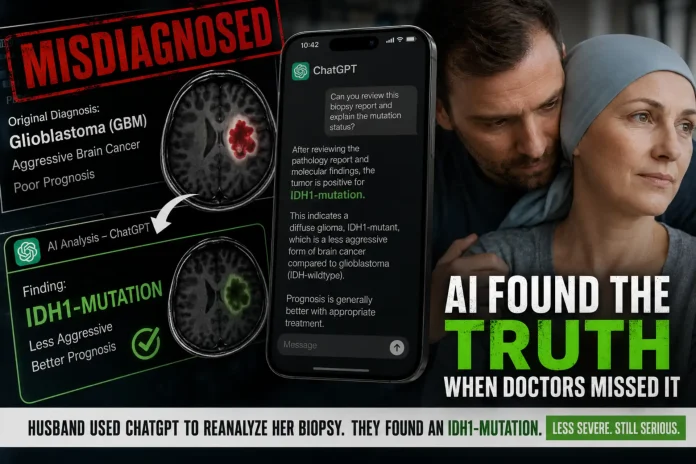
Cole Lemasters used ChatGPT in mid-2025 to review his wife Kiley Lemasters’s recent radiology report and her July 2020 biopsy records. The model surfaced an IDH1 R132H mutation that had been recorded at the time but gained new significance under the 2021 World Health Organization update on central nervous system tumors. Under that update, the glioblastoma label was restricted to IDH-wildtype tumors, and what had been called Kiley’s glioblastoma was reclassified as an IDH-mutant astrocytoma, still grade 4 but with a markedly better median survival measured in years rather than months.
The events unfolded in Missouri. Kiley’s seizure and initial diagnosis came in the Kansas City area at age 18. The couple married on Dec. 18, 2020, in a small rural Missouri church during the COVID-19 shutdowns, and later settled in Columbia, where Cole attended the University of Missouri and Kiley studied at Moberly Area Community College while working as a barista. Five years of stable MRIs ended with her July 2025 imaging, on the fifth anniversary of the grim three-month prognosis that had led 18-year-old Kiley to write a will and pick out a casket.
The process began when Cole copied the dense text of the recent radiology report into ChatGPT for plain-language explanations of terms describing a small new enhancing focus near the resection cavity. The AI clarified the finding as a common post-treatment effect and, when Cole asked about the original diagnosis and long-term stability, pointed to the 2021 WHO update. Cole retrieved a box of 2020 pathology documents from his mother-in-law and uploaded pages one by one, about 60 in total over an hour, until the model highlighted the positive IDH1 R132H result in the molecular-genetics section of the original report.
The original 2020 diagnosis rested on histological features available at the time and the classification rules then in force, when IDH-mutation testing was not always performed routinely on every sample. Pathologists and oncologists applied the standards correctly for that era, yet the mutation data already present in Kiley’s records gained new significance only after the WHO revision. Her current neuro-oncologist reviewed the AI-surfaced finding, confirmed its validity against the updated criteria, and adjusted the care plan from short-horizon crisis management to long-term monitoring. The couple, still in the Columbia, Missouri, region, have shifted focus toward careers, housing, and possible family plans since the prognosis improved.
In the broader health sector, AI tools already assist with rapid analysis of MRI scans through deep-learning models that predict IDH-mutation status from imaging alone, often achieving high accuracy without an immediate need for invasive biopsy in research settings. Digital pathology systems apply convolutional networks and vision transformers to histology slides to estimate molecular profiles including IDH status, glioma grade, and other markers, speeding turnaround and reducing variability among readers. Large language models like ChatGPT help clinicians and patients parse lengthy reports, cross-reference guidelines, and surface overlooked details across multiyear records, serving as a second set of eyes rather than a replacement for medical judgment. Ongoing research includes fully automated MRI-based networks that forecast IDH mutations preoperatively, hybrid radiomics-deep-learning pipelines, and AI-driven molecular profiling from tissue images. Multiple 2024 and 2025 studies have demonstrated performance that can match or exceed certain physician groups in controlled comparisons, while still requiring clinical validation.
These developments point toward integrated workflows in which AI flags potential reclassifications, prioritizes cases for molecular testing, and supports shared decision-making, particularly as classification systems evolve. For patients with long-stable disease under older labels, systematic review of archived molecular data against current guidelines can alter treatment intensity and life planning. The Lemasters experience illustrates the practical value when AI connects existing information across time and helps families pose precise questions to their care teams, always with final confirmation by specialists. The full personal timeline appears in a Christianity Today account of how an AI-assisted review uncovered the misclassification. The patient-facing summary of the 2021 classification shifts is outlined on the National Brain Tumor Society’s overview of the 2021 WHO CNS tumor reclassification. Examples of AI advancing brain tumor imaging and diagnosis are covered in an NCI Cancer Currents feature on AI-assisted intraoperative brain-tumor diagnosis. OpenAI’s official account summarized the reclassification in a post about the Lemasters family and the IDH-mutant astrocytoma finding.