

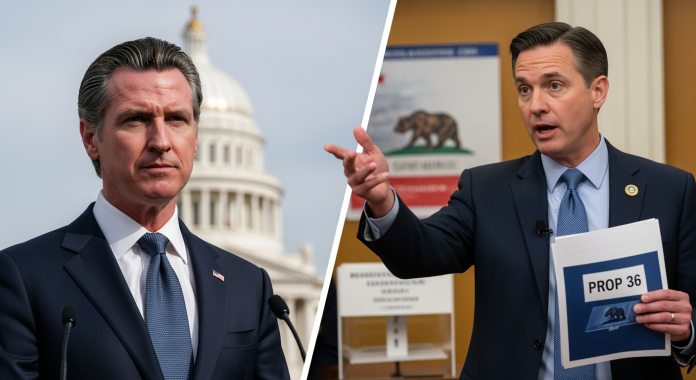
California voters intervened to rescue the state from escalating crime rates, according to Rep. Kevin Kiley, who credits Proposition 36 as a key factor. This assertion sparks a fierce political debate, pitting Kiley against Governor Gavin Newsom and underscoring the contentious struggle to address public safety in California.
California has long grappled with rising crime, particularly property offenses, which have intensified public concern. This trend gained complexity during the COVID-19 pandemic, which altered typical crime patterns. Simultaneously, the state implemented several criminal justice reforms.
Governor Newsom’s administration has faced scrutiny over policies such as Assembly Bill 109, Proposition 47, and Proposition 57. Critics contend these measures inadvertently contributed to increased crime rates. The public’s perception of public safety has frequently diverged from official statistics, fostering a charged political environment surrounding California crime reform efforts.
California is getting safer because we beat Governor Newsom. He repeatedly tried to sabotage Prop. 36, our initiative to make crime illegal again. But the people of California passed it overwhelmingly and now thieves are actually being prosecuted.
— Rep. Kevin Kiley (@RepKiley) December 22, 2025
Policies under Governor Gavin Newsom, designed to reform the criminal justice system, have become a focal point of contention. Supporters argue these reforms address over-incarceration and racial bias, while opponents claim they have emboldened criminal behavior. Proposition 47, which reduced penalties for specific property crimes, has notably drawn significant criticism.
These disagreements highlight fundamental differences in addressing public safety and California crime reform across the state’s political spectrum.
Amid this climate, Proposition 36 emerged as a citizen-led initiative. It aimed to “make crime illegal again” by tightening penalties, focusing on enhanced sentences for repeat offenders and addressing the early release of inmates. Overwhelmingly passed by California voters, this ballot initiative included specific provisions intended to increase accountability and deter criminal behavior. This direct action by the electorate signaled a clear preference for the state’s future approach to crime.
The disagreement between Rep. Kiley and Governor Gavin Newsom reflects this broader debate. Kiley has consistently criticized Newsom’s crime policies, advocating for stricter penalties and greater law enforcement support. Their political narratives underscore differing views on policy effectiveness.
Kiley argues that Proposition 36 has initiated a reversal of rising crime trends. In contrast, Newsom’s administration prioritizes rehabilitation and addressing the root causes of crime. Legislative disputes and public commentary continually highlight these diverging ideologies on California crime reform.
Early data and analyses regarding the impact of Proposition 36 are still developing. Discussion continues on whether the initiative is directly responsible for any observed shifts in crime rates. Some proponents claim it has positively deterred criminals, while others suggest any changes are not yet significant enough to be conclusive.
The full effectiveness of the ballot initiative remains a contested topic, subject to ongoing research and evaluation. This measure is actively shaping the future of crime control in California.
The narrative surrounding Proposition 36 underscores the power of citizens in shaping criminal justice. It demonstrates that voters can directly influence policy and hold leaders accountable. As California navigates the complex issues of crime and punishment, the ultimate impact of Proposition 36 will likely be crucial in determining the state’s future course. This highlights the enduring importance of public participation in governance as the ballot initiative continues to unfold.
