What happens when a machine can do your job but society decides it shouldn’t?
Microsoft co-founder Bill Gates raised that exact question in a nearly 6,000-word essay published August 26, 2026, on Gates Notes. Titled “The turbulent AI era is here. The choices we make now are critical,” the piece delivers a blunt warning: governments are not prepared for the disruption AI will bring.
“Many jobs will disappear forever,”
Gates wrote.
“I believe that as AI and robots improve, we’ll set aside certain things for only people to do.”
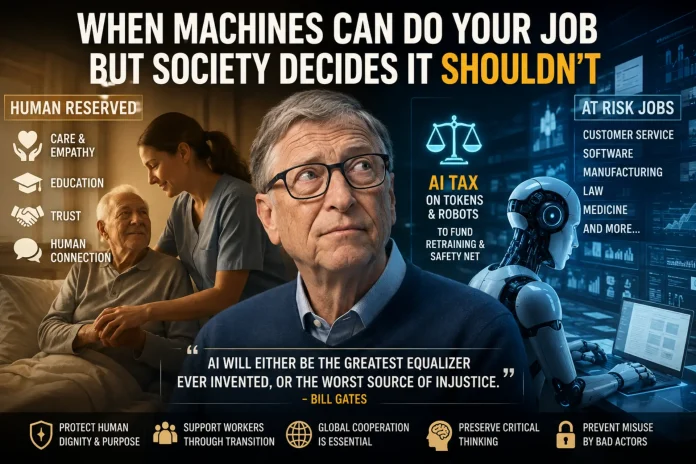
He calls this domain “human reserved.” The phrase, he explained,
“makes me think of nature reserves places where we could put buildings and roads, but we choose not to because the loss would be too great.”
Gates points to roles where empathy, trust and human connection matter most. He recalled the caregivers who looked after his father during Alzheimer’s disease.
“Something in the care they gave my dad was irreplaceably human, no robot could or should have done it,”
He said. Another example:
“Imagine a robot giving you the awful news that you have an incurable disease. There’s no technical reason why it couldn’t. Yet it shouldn’t.”
Some protections could be temporary. Gates noted that a long-career construction worker or manufacturing employee nearing retirement cannot simply retrain overnight. Society might shield those roles for a period to ease the transition. In education and healthcare, the approach could be hybrid humans remain in charge while using AI tools.
For American workers, young people and families, the stakes are concrete. Entry-level positions in law, customer service, medicine, software and manufacturing face pressure first. Fewer starter jobs make career ladders harder to climb. Families in communities hit by concentrated losses would feel the strain fastest.
Gates also proposes taxing AI tokens and robots. Current rules often treat machines as capital that can be written off quickly, while human payroll triggers taxes. A targeted levy, he argued, would
“slow the rush away from human labor a little and raise money for retraining and a stronger safety net.”
He calls for stronger U.S. institutions that can coordinate AI’s effects across employment, education, taxation, security and health on a scale larger than the post-9/11 national security reorganization. International cooperation is essential, including between the United States and China, he said.
Gates highlighted three core dangers. First, permanent job disruption: AI substitutes for cognition itself, not just physical labor, and can shrink the overall number of good jobs. Second, misuse by bad actors easier cyberattacks, deepfakes, or even biological risks. Third, damage to human relationships and critical thinking, especially among young people who may lean too heavily on AI companions or tools.
“AI will either be the greatest equalizer ever invented, or the worst source of injustice,”
He wrote.
“Even under the best circumstances, the transition to this new AI era will be one of the most turbulent times in human history. Right now, we are not preparing for it.”
Who decides which jobs stay human? Could taxes on AI and robots slow useful innovation or push companies overseas? Would U.S. firms lose ground if other countries automate faster? These practical hurdles remain unresolved.
In the AI age, should America protect jobs because humans are better at them or because being human still matters even when machines can do the same work?