

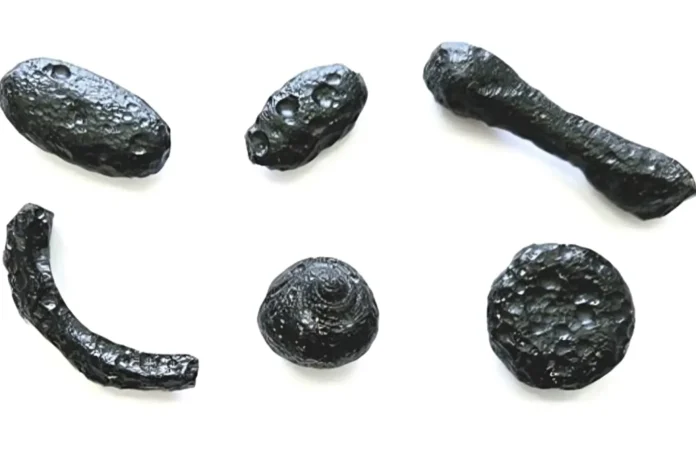
You scroll through X, and bam there it is. A post from @nexta_tv drops with a UFO emoji and the headline: “Alien-origin fragments discovered in Brazil.” Black, shiny chunks of glass stare back from the photo, sparking wild theories in the comments. Is this proof of extraterrestrials crashing on Earth? Spoiler: no. But it’s still a killer science story straight out of Brazil’s backcountry.
The viral tweet, posted on February 25, 2026, racked up thousands of views by highlighting these mysterious bits. Turns out, they’re not from space invaders. They’re tektites Earth-made glass born from a massive asteroid smash. Let’s break it down.
Geologists tromping through the dusty hills of Minas Gerais, Brazil’s mining heartland. Leading the charge is Álvaro Penteado Crósta, a professor at the State University of Campinas. His team, pulling in experts from Europe, the Middle East, and Australia, hit paydirt starting in 2023.
A tweet from X.
By late 2025, they’d scooped up over 600 samples some as hefty as 85 grams. These “geraisites,” named after the state, popped up first in spots like Taiobeiras and Curral de Dentro. The field stretches at least 90 kilometers, but fresh finds push it toward 900 kilometers into Bahia and Piauí.
Crósta shared in a recent update:
“This growth in the area of occurrence is entirely consistent with what is observed in other tektite fields around the world. The size of the field depends directly on the energy of the impact.”
The paper dropped in the journal Geology on December 2, 2025, sealing the deal.
Tektites aren’t your grandma’s beach glass. When an asteroid slams into Earth, it blasts rocks into molten blobs that shoot skyward. These cool into aerodynamic shapes mid-flight think teardrops, spheres, or twisted lumps.
Geraisites look black at first glance, but hold one to the light? They glow gray-green and translucent. Their secret sauce: super-low water content, just 70-110 parts per million. That’s way drier than volcanic obsidian, proving the impact origin. Chemically, they’re dacite-rhyolite mixes from ancient crust, about 3 billion years old.
The hit happened around 6.3 million years ago, per argon dating. No crater spotted yet maybe it’s buried or eroded away.
This find marks the seventh known tektite strewn field worldwide, plugging a huge hole in South America’s impact history. Before, the continent had slim pickings on cosmic crashes. For U.S. readers hooked on planetary defense think NASA’s asteroid watches it sharpens our grasp of how these events reshape Earth.
It reminds us impacts aren’t just dinosaur killers; they’re part of our planet’s pulse. Plus, it shows how overlooked spots like Brazil can rewrite global stories.
The hunt’s on. Teams are modeling the blast’s power and scanning for that elusive crater. More argon tests could tweak the age. Crósta’s crew keeps expanding the map, hinting at even bigger fields out there.
In a world buzzing with space news, this Brazilian breakthrough blends adventure with hard facts. Who knows what else hides in plain sight?

