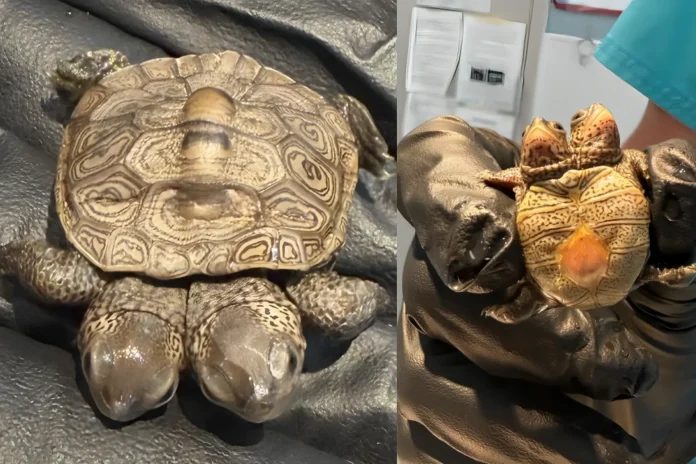
There was an unforeseen discovery made at one of the nesting grounds which are being protected by Cape Cod’s wildlife authorities.
The miniature diamondback terrapin, weighing around 5.2 grams equivalent to two adult fingers was taken to the Cape Wildlife Center of Barnstable with its two heads fully working. The discovery of the reptile was made by the staff at the Mass Audubon Wellfleet Bay Wildlife Sanctuary, where the reptile hatched and was found near September 17. Pictures were immediately uploaded on Facebook by the center, which is a subsidiary of New England Wildlife Centers.
This phenomenon is called bicephaly, which is very rare and happens when an embryo fails to split properly, leading to the formation of two heads on the same body. This is just like conjoined twins, but it is still quite rare even for reptiles.
New England Wildlife Centers CEO Zak Mertz told reporters the initial veterinary assessment was positive.
“What I’ve heard from the vet team is that they are behaving normally, and both sides are looking very good,”
Mertz said. The center noted it has seen only two other bicephalic turtles in the past five years despite handling hundreds of turtles annually, calling this an especially rare case.
Vets, including wildlife medical director Dr. Priya Patel, are keeping close tabs on the health, behavior, and appetite of the hatchling. There is some yolk left inside of the animal, thus the experts will have some time to watch the case before starting with feeding. Now the professionals use only one case number because of the practical questions that appear when two brains have one body. But later, after conducting more diagnostics, the experts will be able to see how many internal organs they share.
Diamondback terrapins (Malaclemys terrapin) live in salt marshes and estuaries along the Massachusetts coast and are listed as threatened under the state’s Endangered Species Act. Habitat loss, road mortality, and other pressures make protected nesting sites and rehabilitation programs especially important. Finding the hatchling at a monitored site allowed it to receive care rather than face the usual risks of the wild.
A similar two-headed diamondback terrapin turned up in the region in 2021. That earlier animal had six legs and showed more distinct separation in some systems, but each case is different. Experts caution against assuming the same anatomy or outcome for the current hatchling.
It was already mentioned that two-headed reptiles can experience some difficulties with moving, competition for food or working together because of the shared organs, even when both heads are active at first. The Cape Wildlife Center did not provide the prognosis for the future yet. The experts just continue observing and learning from these cases.
At the moment, the 5.2-gram hatchling receives professional care. It shows both unpredictability of nature and importance of the conservation efforts that allow people to find such cases.