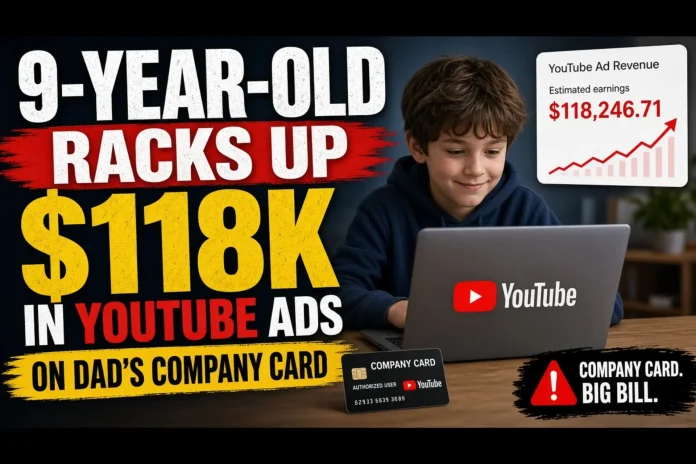
A 9-year-old Minecraft and Roblox YouTuber running the channel Mighty Mike Plays (@MightyMikePlays67) ran up roughly $118,000 in YouTube advertising charges on his father’s company credit card over about three weeks, according to the father, who said the bill was discovered only when his employer’s finance team pulled him into a meeting.
Dave, the father — who identifies himself as David Sarkisyan and works in marketing — laid out the charges in a video posted Tuesday to his son’s channel titled “Message from Dad… Mighty Mike Plays is Over.” The video opens with 9-year-old Mike introducing himself; when his father asks if he has anything to say to viewers, Mike replies: “I’m definitely cooked.” Dave tells viewers the family now plans to remove saved payment details, add spending caps and set parental controls, and that the channel could be paused while the situation is reviewed.
In the video, Dave says the channel began as a casual father-son project when Mike was around 8. The boy started uploading gameplay captured from a PlayStation 5 with a cheap headset and no editing after watching others play Minecraft and Roblox online; early videos drew between five and eleven views, Dave says. Mike kept recording because he enjoyed it, even as the channel failed to gain traction.
The spending started with a small promotion. After Mike complained that the channel was not attracting views or subscribers, Dave said, he set up a roughly $20 YouTube advertising campaign and walked his son through it aloud: set a budget, choose the audience, hit run. The company credit card was already saved to the shared Google account from a previous purchase — Robux for Roblox, Dave says, explaining why the card sat on file but not why he used the company card for that earlier buy.
Mike then returned to the advertising tools on his own. “He didn’t really register that that was supposed to be some kind of limit in his head,” Dave said in the video. “The logic was simple, I guess. More money, more views.” No spending limits or parental controls were in place, Dave added. “The credit card, it just says approved every single time,” he said.
The campaigns promoted specific Mighty Mike Plays uploads, including titles referencing “Mighty Mike,” “Epic Roblox” and Minecraft gameplay, and ran for about three weeks. According to GamesRadar, at least one of the promoted ads was a 34-minute Mighty Mike video uploaded in its entirety. Tom’s Hardware measured the channel’s three most-viewed gameplay videos at 260,000, 224,000 and 178,000 views as of 12:26 a.m. ET on Sept. 16.
Dave said he learned the total only when his manager, corporate representatives and finance staff called him into a meeting. “Today, I got a call into the office at work,” Dave said in the video, according to BroBible. “I walk in and we’ve got the corporate manager, we’ve got people from finance. They pull up a laptop, show me some tables on the screen, and basically ask me to explain why there’s $118,000 missing from the company card assigned to me. I didn’t really have an answer at first, but once we saw where all of the actual transactions were going, I connected the dots.” Dave added: “There is a real, genuine chance that I end up having to personally pay some of that or all of that back out of my pocket,” and he could be fired as a result.
The story is not the first time a child has spent heavily through a parent’s saved payment method on a Google product. On Sept. 4, 2014, the Federal Trade Commission announced that Google would refund at least $19 million to parents whose children had made unauthorized in-app purchases on Google Play, and required the company to obtain express consent before billing. Reporting from the Associated Press and CBS News covered the settlement at the time. The Mighty Mike case involves YouTube Promote and a credit card on file rather than Google Play in-app charges, and the family — not Google — is the bill-payer here, but it sits in the same regulatory neighborhood of children spending through parents’ accounts without spending caps.
Google’s own product rules do not, on their face, prevent what happened. Google Ads policy does not allow users under 18 to run campaigns, but in Mighty Mike’s case the account belonged to his father. YouTube’s Promote tool — which Google describes as a simplified version of Google Ads — walks creators through a goal, an audience, a budget and an end date, a flow that matches the steps Dave said he talked Mike through. Spending caps on YouTube Promote are set by the campaign creator, not by the platform, and Google does not require a second-factor confirmation for additional campaigns after the first. Family Link, Google’s parental-control app, can require parental approval for Google Play purchases, but Mighty Mike’s ad campaigns were billed through a Google Ads payments profile tied to the father’s saved card, not through a supervised child account.
Where the case sits in the wider creator economy is its own story. The Mighty Mike channel had about 24,000 subscribers and 182 uploads as of early Sept. 16, per Tom’s Hardware; the end-of-August baseline was roughly 3,700 subscribers. After Dave’s Tuesday video went live, subscriber counts climbed past 40,000 and the explanation video itself pulled in more than 400,000 views, according to BroBible. That viral arc has fueled speculation — flagged by BroBible as one possible explanation — that the entire incident is a content stunt to grow the channel, a reading Dave has not addressed directly. Either way, the math illustrates how a child’s spending on a parent’s saved card can collide with a creator economy in which a single viral video is worth more than the cost of buying attention to it. The same week saw MrBeast pulling in roughly $4 million per month from YouTube according to leaked earnings figures, and a story about an 8-year-old YouTuber who built a large channel around his love of Roombas — both reminders that the platform’s youngest creators can command real audiences, and real money flows.
Dave has taken responsibility for leaving the payment method accessible without safeguards. Dexerto reported that Dave said the family plans to remove saved payment details, add spending caps and set up parental controls. The Mighty Mike Plays channel could be paused while the situation is reviewed, the outlet reported. Hypefresh has separately tracked cases in which a public figure was accused of putting a partner’s payment method to unexpected use, including the allegation that Will Smith used streamer xQc’s credit card for Twitch gifting. Those cases differ in motive and scale, but the throughline is the same: a saved card on a shared account is a single point of failure when neither the platform nor the cardholder has built in a second gate.
The $118,000 figure and the description of the company’s response come solely from Dave’s account and have not been independently verified by news outlets covering the story. Dave did not provide receipts or charge documentation, per Tom’s Hardware. The promotional spending is separate from any revenue the channel might earn from views, and no figures have been reported showing the cost was recovered through ad earnings or other income. As of Wednesday evening local time, neither Mighty Mike Plays nor the company had issued a separate statement beyond Dave’s video.