

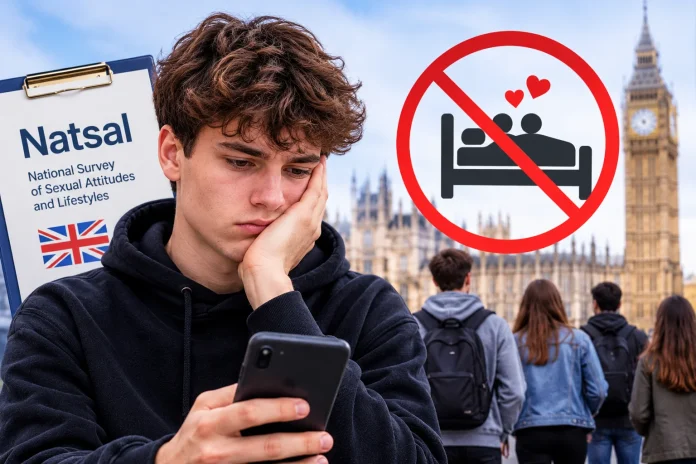
A massive new survey just dropped a bombshell on Britain’s sex life: roughly one in three 16- to 24-year-olds has never had sex — and the number has roughly doubled since 2010.
The fourth National Survey of Sexual Attitudes and Lifestyles (NATSAL-4), out today in The Lancet, paints a clear picture of Gen Z in the UK choosing to slow down, opt out, or go digital while the rest of us are still stuck in the 90s.
Here’s the raw data:
Sexual frequency has halved
Adults under 45 now have sex an average of twice a month (down from four times a month in 1990). Under-25s? Less than once a month.
77% of 16–59-year-olds are still sexually active with a median of five lifetime partners — but the trend is sharply downward, especially among the young.
The “never had sex” reality check
- 37.7% of young women
- 28.4% of young men
aged 16–24 have never had sex. That’s up from under 19% in 1990 and 18.9% of women / 18.2% of men in 2010–12.
68% of 23-year-olds still live at home — three times the rate from a decade ago. Researchers say that alone has slashed opportunities for the kind of socialising and hook-ups that used to happen.
Porn and sexting everywhere
While real-life sex is down, digital sexual stuff is up:
- 90% of young men and 50% of young women watched porn in the past year.
- About half of 16–24-year-olds have sent or received sexual images (sexting).
- Overall, 81% of men and 37% of women did it last year.
The most interesting twist? People who had never had sex were less likely to watch porn. It’s not replacing sex for everyone — it’s just filling a different space.
Same-sex experiences have also surged: doubled for women (6.8% to 14%) and tripled for men (4% to 12.3%) since 2010–12.
Experts are calling it a mix of factors — living longer with parents, gaming and streaming instead of nights out, cost-of-living pressure, mental health issues, and a consent culture that’s made dating more selective.
Dr William Marsiglio, a leading NATSAL researcher, summed it up: “This is the biggest, most detailed look at British sexual behaviour in 30 years. The data show a clear decline in partnered sex, especially among the young, alongside a big rise in digital practices. We need updated education, services and policies yesterday.”
NATSAL-4 is the first wave to include full online self-completion, giving everyone more privacy. It’s also the latest in a global trend that’s playing out in other Western countries.
Britain’s young people are more connected than ever — but they’re having sex at the lowest rate in three decades, while still diving headfirst into the new digital sexual world.
The full NATSAL-4 report is open access in The Lancet and already being discussed everywhere from BBC to The Guardian. If you’re 16–24 and reading this, the stats are real — and the party’s just getting started online.
