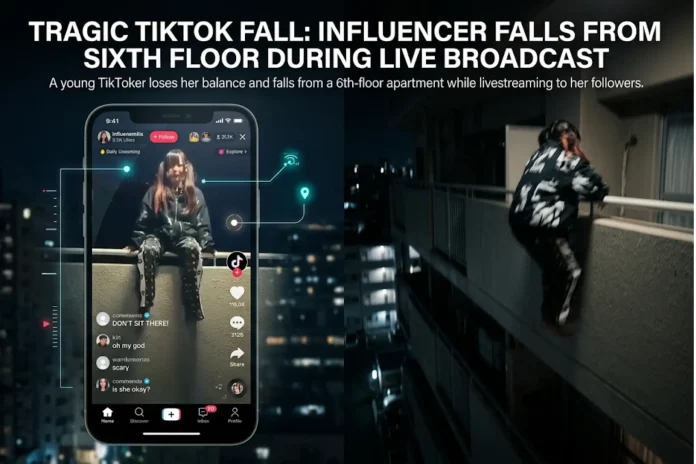
A nighttime livestream that began with a person climbing onto a concrete balcony railing and ended with an empty frame lasting roughly 44 minutes continues to circulate online after posts from an X account named Ruka announced a planned jump broadcast in mid-November 2026. Secondary international reports have described the person as a 14-year-old Japanese middle-school student who suffered fatal head injuries after falling from a sixth-floor apartment, yet major Japanese outlets including NHK, Asahi Shimbun and Yomiuri Shimbun have published no confirmation of the identity, age, location or outcome, and no accessible statement from Japanese police has verified the claims.
The footage, shared under the Japanese title “とびおりふ,” shows a young person in a dark hoodie patterned with white crosses, black-and-white patterned trousers and pink fuzzy slippers left on the balcony floor. At points the person faces the camera, moves along the low metal railing and sits with legs dangling over the edge of what appears to be an apartment building at night. Viewers who watched the original stream have reported hearing phrases translated as “I’m hungry,” “I’m scared” and “this is dangerous.” The person then drops out of the frame. The camera remains fixed on the empty balcony and distant city lights for the remainder of the roughly 44-minute broadcast.
The X account @usamogv, which displays the name Ruka and was created in May 2026, posted messages on November 13 that Japanese-language accounts translated as “I will jump” and “I’m going to livestream a jump. Everyone come.” A subsequent post linked the “とびおりふ” broadcast that appeared early on November 14. A Japanese blog that examined the public posts noted earlier references to death or self-harm dating back to July and August 2026. The account had accumulated roughly 10,000 followers by the time the stream circulated. No independent source has confirmed that the person in the footage is the account holder, that the individual was 14 years old, or that any medical outcome followed the fall from view.
Initial reports attributed the stream to TikTok. Later accounts, including those citing the X broadcast link and the 44-minute duration, pointed to the platform formerly known as Twitter. Outlets such as IBTimes UK and Haberler repeated the middle-school-student identification and the reported phrases, while noting that no authenticated transcript exists and that emergency-response timing remains unknown. Colombian and other secondary coverage has similarly flagged the absence of official Japanese statements. Japanese privacy practices around minors and non-publicized cases often limit early domestic reporting even when international social media has already amplified footage.
The continued empty livestream has drawn separate questions about platform monitoring. The feed remained active long after the person left the frame, raising the issue of whether automated or human review systems flagged a prolonged outdoor balcony scene after prior posts that referenced jumping. No public statement from X has detailed any review of the specific broadcast. Comparable incidents involving young people and live content have included a climber who fell during a Yosemite stream in 2025 while hundreds watched and a 14-year-old who slipped at a waterfall in Myanmar while posing for photographs. Compilations of such cases number in the hundreds when falls from height, traffic filming and other high-risk activities are counted together.
Surveys of Gen Z users have recorded elevated rates of anxiety after social-media sessions and pressure to produce attention-grabbing material. One set of figures has placed post-use anxiety near 59 percent and the felt need to post high-stakes content near 71 percent in certain samples. Large reviews have linked heavy screen time with higher risks of sleep disruption and loneliness, with some associations stronger among girls. The algorithmic reward for novelty and extremity can intersect with still-developing risk assessment in adolescents. In this case the pre-announcement of a jump stream supplies a documented sequence that secondary reports have not always included.
Japanese police, if they opened an inquiry, have not released findings that name a victim, a building or a determination of accident versus intent. Friends and viewers have told secondary outlets that the person faced recent personal pressures, but those statements remain secondhand and unconfirmed. The slippers left on the floor and the extended empty frame are visible in the circulating video. Everything beyond those visible elements—the precise floor, the city, whether help arrived, and whether the fall produced fatal injuries—rests on unverified secondary accounts. Until Japanese authorities or primary medical sources speak, the circulating story rests on the footage itself and the posts that preceded it.
The gap between rapid international amplification and the absence of domestic confirmation is itself part of the record. Platforms host both the pre-announcement and the long empty stream. Viewers worldwide have now seen the railing sequence. Japanese reporting, constrained by privacy norms and the lack of an official release, has not yet matched that volume. The result is a story whose most concrete elements remain the posts from @usamogv and the 44-minute video that begins with a person on the railing and ends with an empty balcony.