

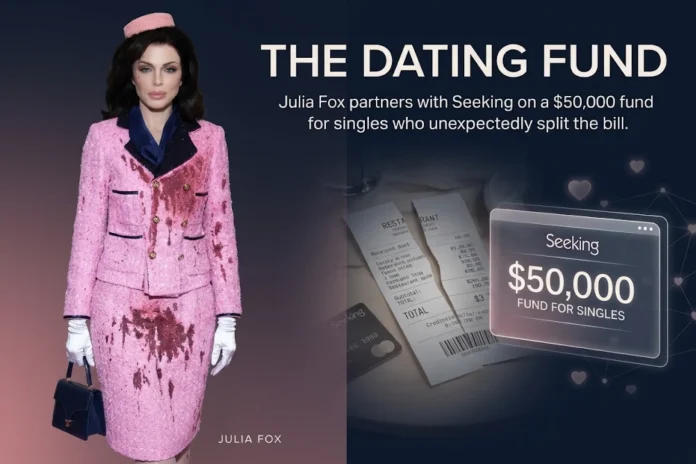
Julia Fox has fronted Seeking’s Anti 50/50 Campaign, which sets aside a $50,000 fund to reimburse eligible singles up to $50 each when a date unexpectedly asks them to split the check. The offer launched November 10 and runs through February 10, 2027, or until the money is gone.
Applicants must create a new free U.S. account at seeking.com/bad-date-fund, finish a profile, submit the details of the date, and upload a receipt. Alcohol, tips, and delivery fees are excluded. Approvals arrive by email within 30 days on a first-come, first-served basis. Those who qualify receive a secure payment link they must use within 60 days.
Fox, 36, put her name on the effort after telling the company she has used the platform herself. “I’ve been on Seeking, my friends have been on Seeking, and I think we need to get over the idea that women should have to justify what they want out of dating,” she said in materials released with the launch. “I’m all for women being independent, but that doesn’t mean we have to entertain low-effort men who think splitting a check is the height of romance. If you’re going to court somebody, COURT THEM.”
The actress and model, born Julia Francesca Fox in Milan and known for her role in the 2019 film Uncut Gems, has spoken publicly for years about the effort women put into dates and the expectation that men should cover the bill. Her involvement fits a pattern of blunt commentary on dating norms that has circulated on her social channels and in interviews.
Seeking’s own research, cited across its announcement and blog, found that 61 percent of Gen Z women reported being asked to split a first-date bill, more than double the 27 percent figure among Boomer women. At the same time, 75 percent of women in the survey said they prefer men to take the lead on planning and paying. Among the platform’s users, 92 percent of men prefer to pay on a first date and 67 percent of women said they would turn down a second date if the bill was not covered.
Co-CEO Dana Rosewall framed the campaign as a correction. “We’re giving women their money back while encouraging men to lead with generosity,” she said. “Somewhere along the way, the patriarchy convinced women that splitting the bill was empowerment, when really it just made being cheap socially acceptable.” Founder and co-CEO Brandon Wade added that “people love to say money doesn’t matter in dating, but the people saying that usually aren’t the ones paying the price. Love may be priceless, but dating has never been free.”
Seeking began in 2006 as SeekingArrangement, a site that openly matched successful men with younger women in arrangements that often involved financial support. After years of rebranding and a formal prohibition on transactional relationships, the Las Vegas-based company now markets itself as a luxury dating platform with more than 56 million members across 130 countries. Wade and Rosewall, who met on the site in 2020 and married in 2022, returned as co-CEOs in 2024.
The timing lands amid broader cost pressures on young daters. A September 2026 Zelle survey of 1,800 Gen Z and millennial adults who had dated in the prior year found that 84 percent said rising costs affected their dating lives and 11 percent had stopped dating altogether because they could not afford it. Separate reporting has tracked similar pullbacks, with many respondents shifting toward cheaper or free activities.
The campaign also includes an exclusive merchandise line whose proceeds feed back into the fund. Seeking has not released sample size, field dates, or methodology details for its generational survey beyond the published percentages. The company says the reimbursement is open to qualifying members who split a check on a date, even as its messaging centers on women and first dates.
For those who qualify, the process is straightforward once the account exists. The fund’s limit means the $50 payouts will stop once the $50,000 is claimed, regardless of the February 2027 end date. Fox’s quoted stance and the platform’s user preferences both treat covering the bill as ordinary courtship rather than an optional extra.

