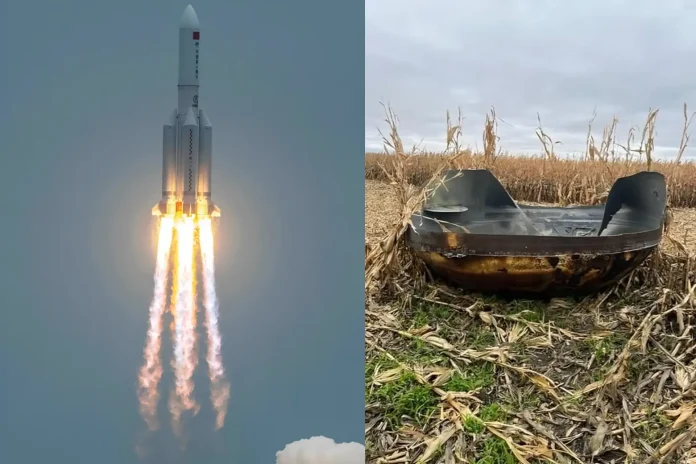
A Minnesota farmer combining corn on October 14, 2026, stopped short when his machinery nearly hit a massive, charred metal object sitting among the stalks in Scott Township, Stevens County.
The bowl-shaped piece measured about 11 feet (3.35 meters) across. The Stevens County Sheriff’s Office responded that afternoon, describing it as “a large, metallic object, approximately 11-feet in diameter, presumably a space object.” Officials confirmed it posed no danger to the public, notified state and federal partners through the Minnesota Duty Officer, and removed it within two days for secure storage.
A U.S. State Department spokesperson later stated the debris “has been secured and poses no danger to the public” while interagency partners work to determine its origin.
Space trackers quickly connected the object to a Chinese launch. On September 15, 2026, LandSpace’s Zhuque-2E rocket lifted off from the Dongfeng commercial zone near Jiuquan in northwest China carrying 10 Qianfan networking satellites. The upper stage has a matching 11-foot diameter. Experts including Jonathan McDowell noted the stage reentered on its first orbit that same day, with fireballs reported over Kansas heading north toward Minnesota consistent with the recovery site near the predicted ground track. The charred, dome-like appearance also fits a fuel-tank end cap that survived atmospheric heating.
Most rocket stages burn up on reentry, but denser metal components can reach the ground. Experts prefer controlled deorbits over remote ocean areas precisely to limit this risk. With launch rates rising for satellite constellations, uncontrolled or poorly directed returns become a growing practical concern even when no one is hurt, as happened here.
This find in an ordinary Minnesota field shows how space activity can leave tangible traces on the ground and underscores the need for precise disposal practices as more hardware returns from orbit.