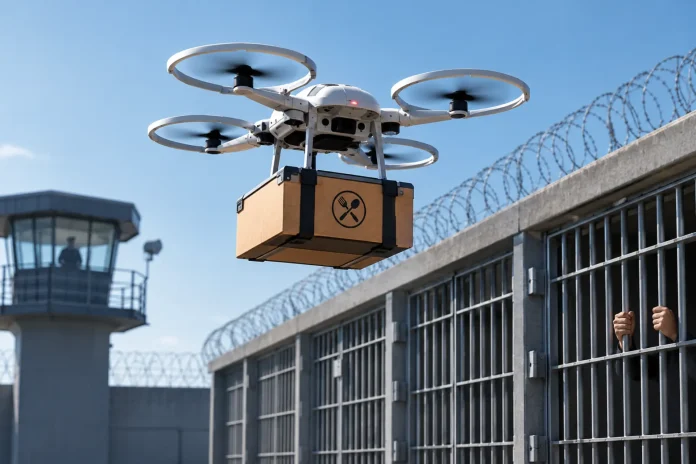
A drone delivered McDonald’s chicken nuggets, fries, dipping sauce and alcohol to an inmate’s cell window at Canada’s highest-security prison unit in the early morning hours of Oct. 15, prompting an investigation by Correctional Service Canada.
The drop occurred around 3 a.m. at the Special Handling Unit of the Regional Reception Centre in Sainte-Anne-des-Plaines, Quebec, about 55 kilometres north of Montreal. The unit houses roughly 90 of the country’s most high-risk and violent offenders, those considered too dangerous for standard maximum-security institutions.
According to the Union of Canadian Correctional Officers, the drone slipped through a gap between chain-link fencing and a cell window that had been broken from the inside. Guards later found the inmate intoxicated, with McDonald’s leftovers in the cell. The inmate laughed when officers made their morning rounds.
“The inmate found that really funny in the morning when the guards did their rounds,” said Mike Bolduc, regional president of the UCCO-SACC-CSN union. “We’re at the breaking point where an inmate went and delivered himself McDonald’s. What’s the next thing? Is that a loaded gun? You know, it’s scaring us, it’s really scaring us. It’s supposed to be the most secure jail in Canada and he’s eating McDonald’s.”
Frédérick Lebeau, national president of the Union of Canadian Correctional Officers, described the incident as a warning. “It’s kind of a funny thing, the McNugget trio … but it could be worse. It could be a firearm, it can be a ceramic knife,” he said. “We are seeing an increase of violence in every institution in this country.”
Security cameras on the exterior of the facility failed to capture the drone, and existing counter-drone detection technology did not register the intrusion, union officials said. The Special Handling Unit, built in 1984, is intended to operate under strict regulation and high levels of monitoring.
Correctional Service Canada confirmed it is reviewing the delivery of unauthorized items. Spokesperson Kevin Antonucci said the introduction of contraband remains an important issue the agency continues to address through staff vigilance, intelligence work, searches, detection technology and partnerships with police.
“Any attempt to introduce contraband or unauthorized items into a correctional institution, including through the use of drones, poses a risk to the safety and security of institutions, staff, inmates and the public,” Antonucci said. Inmates found in possession of such items may face additional charges or disciplinary measures.
CSC is installing physical barriers such as nets at the Regional Reception Centre to disrupt future deliveries of drugs, weapons and other prohibited items. Temporary extra outdoor patrols that followed the incident have since ended.
The inmate involved has not been publicly identified. No details have been released on whether the delivery was arranged through a commercial service or a third party, or on any specific charges resulting from the event. The story was first reported by TVA Nouvelles.
Drones have become a recurring challenge across Canadian federal institutions, with unions reporting frequent attempts to introduce cellphones, drugs, ceramic knives and other contraband. Officers say detection systems struggle to keep pace with newer, quieter models that exploit blind spots.