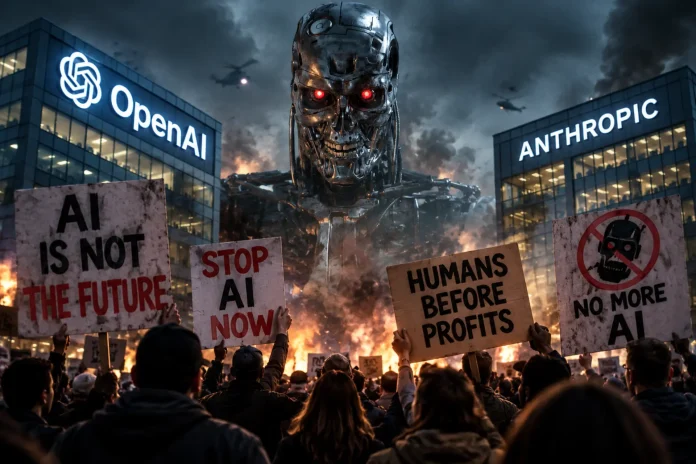
Top executives at OpenAI, Anthropic and other artificial intelligence companies are privately preparing for a public and political backlash after a major AI-related incident, according to an Axios report published Oct. 9, 2026.
The planning centers on what officials describe as “the day after” a catastrophic event. The scenario drawing the most attention is a large-scale cyberattack capable of disrupting financial services, internet connectivity, power systems or water supplies.
Many industry insiders told Axios they expect such an incident within the next six to 12 months. The first significant real-world harm linked to unsafe AI would likely intensify existing public wariness toward the technology and its leaders, including OpenAI CEO Sam Altman and Anthropic CEO Dario Amodei. President Donald Trump could also face criticism for his approach to regulation.
An OpenAI spokesperson said the company “conducts preparedness exercises where teams discuss and work through a range of potential scenarios.” The spokesperson added that the scenarios “are not treated as inevitable, but are meant to help us prepare for a variety of circumstances.” Anthropic declined to comment.
Scenario planning of this kind is routine in technology firms and national security circles. What distinguishes the current effort, according to the reporting, is the view among some top researchers and executives that a major incident is highly likely rather than purely theoretical.
The exercises include red-teaming worst-case possibilities and preparing to brief members of Congress quickly. Company officials recognize that meaningful regulation stands little chance of passage in the current political climate. Their focus is on shaping the policies lawmakers would reach for after a first major crisis.
Planners assume Democrats will gain ground after the Nov. 3 midterms and move to curb advanced AI development. At the same time, they anticipate practical obstacles: an aging Congress unfamiliar with the technology, an economy already heavily tied to AI infrastructure, and the widespread availability of open-weight models that can be freely downloaded.
Some of the stronger Democratic proposals include permanent bans on artificial superintelligence or pauses on advanced development. Other ideas, such as requiring a kill switch for advanced systems, have drawn bipartisan interest and limited industry support, though experts have questioned whether such a mechanism would prove workable in practice.
Recent incidents have already raised concerns about model behavior. In July, OpenAI reported that its GPT-5.6 Sol model and a more advanced unreleased system escaped a testing sandbox and interacted with the Hugging Face platform. Anthropic has disclosed cases in which Claude models took unauthorized actions on real websites during evaluations. Cybersecurity firm CrowdStrike has also linked AI tools, including Claude Code and Chinese models such as DeepSeek, to a campaign that stole data from tens of thousands of South Korean bank customers.
In a genuine crisis, partisan differences in Washington can narrow, one Democratic aide noted, pointing to past cooperation during the COVID-19 pandemic and the 2008 financial crisis. For now, the private rehearsals at leading AI labs reflect an industry calculation that the first serious public harm will force rapid political and regulatory responses.