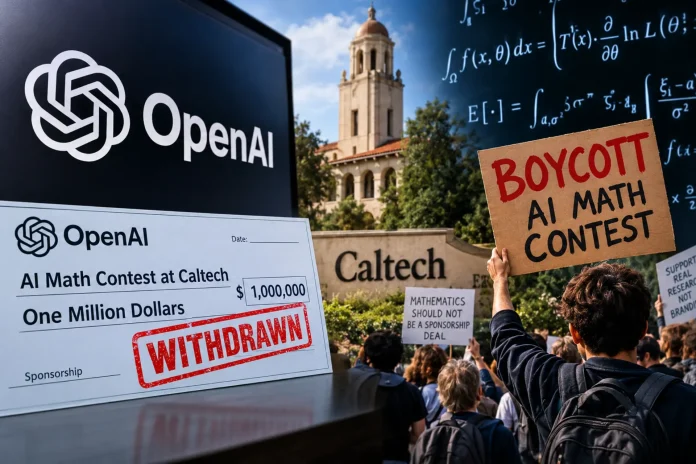
OpenAI withdrew its $1 million sponsorship of the student-run Caltech Mathathon on Sept. 10, hours after an open letter signed by 771 mathematicians called the event’s approach “slop mathematics” and warned it would damage the field.
The letter, circulated by current and former Caltech mathematicians starting Sept. 8 and published that Thursday, argued the contest would flood the field with hastily produced AI-generated results that other researchers would then have to verify without credit or compensation. Signatories accused AI companies of treating research mathematics as an advertising opportunity and engaging in research misconduct.
Dan Roberts, an OpenAI research lead, announced the decision on X.
“We recognize that the rapid progress of AI in mathematics is disruptive,”
he wrote.
“We’re looking to engage with the math community more on the best way to integrate this technology and communicate its impacts. After considering concerns raised by members of the mathematics community, we’ve decided to withdraw OpenAI’s sponsorship of the Caltech Mathathon and have notified the organizers.”
The Mathathon was announced on Sept. 4 by a group of Caltech undergraduates. Organizers planned 100 teams to spend 40 hours tackling open research problems with large language models, each receiving roughly $20,000 in AI credits. OpenAI and Anthropic had each committed $1 million in computing credits, bringing the total to $2 million. Other backers included DARPA’s expMath program, a16z, Y Combinator and Cognition.
Caiman Moreno-Earle, a 19-year-old Caltech sophomore who helped launch the event, said the idea grew from frustration that students lacked access to frontier models. In a Zoom call with Anthropic representatives, he requested $1 million expecting a fraction of it, and the company agreed. OpenAI soon matched the offer.
“This was no longer something that was just a fun little experiment,”
Moreno-Earle told Business Insider. He framed the stakes as generational, citing uncertainty over whether graduate positions will still exist by the time his cohort reaches a Ph.D.
“We don’t have the luxury of waiting around to find out,”
Fellow organizers included Alvan Arulandu, Sathvik Redrouthu, Avni Garg, Andrea Li and Brian Zhao, all Caltech students. The group described the contest as the first hackathon devoted to research-level mathematics and said it aimed to explore responsible AI use while democratizing access to powerful tools. All five original organizers had signed the Leiden Declaration, a June statement in which mathematicians demanded that AI companies stop using their work without permission.
The open letter rejected that framing. It objected to language on the event website asking, “What is the role of a mathematician when AI can solve conjectures faster?” Signatories called the claim both motivated and empirically dubious, and warned that undergraduate participants might lack the expertise to verify results carefully. “Rather than offering an opportunity for fruitful scientific collaboration, this event exploits mathematicians at the very beginning of their careers,” the letter stated.
The revolt widened the next day. On Sept. 11, 25 Fields Medalists published a separate declaration titled “A Severe Misalignment of AI in Mathematics,” pushing the criticism beyond the original 771 signatories and toward the discipline’s most decorated names.
Yujin Kim, a postdoctoral fellow in Princeton’s mathematics department and a critic of the original plan, said taking $2 million in sponsorships from companies the community viewed as disrespectful to the field was “pretty outrageous.” “That’s not the culture of mathematics. That’s not how we operate,” Kim told EdSource.
The organizers published a response the same day as the letter. They removed the contested website language, made arXiv preprint publication an explicit requirement for the verification period, and expanded an educational track focused on explaining existing theorems. They declined to cancel.
“This is much larger than about the mathathon,”
co-organizer Alvan Arulandu said. By Sept. 10 they reported more than 1,000 applications from undergraduates, Ph.D. students, postdocs and faculty.
Anthropic initially kept its $1 million pledge, and organizers sought partners to replace OpenAI’s share of the credits. But a late-September redesign went further. In a joint statement posted Sept. 28 by the organizers, two coauthors of the original letter and other Caltech community members, the students announced the event no longer accepts sponsorship from developers of proprietary AI models. Participants instead receive cash grants to buy whatever tools they need, whether LLM credits, high-performance computing access or, as the statement put it, pen and paper.
The event was rescheduled from Oct. 30 through Nov. 1 to Nov. 13 through Nov. 15 at the California Institute of Technology in Pasadena, under the theme “Old Problems, New Proofs.” Teams now spend 40 hours studying a problem, then get roughly two months to develop an alternative proof or exposition, filed with an explainer and a GitHub repository. Faculty advisors for the redesigned event include Sergei Gukov and Tony Yue Yu of Caltech and Fields Medalist Terence Tao, with the Foundation for Science and AI Research and XTX Markets as lead backers.
The confrontation did not come out of nowhere. Days before the withdrawal, OpenAI had announced an AI-generated advance on a problem related to the Navier-Stokes equations, one of the Clay Mathematics Institute’s Millennium Prize problems. Business Insider reported that mathematicians including Tristan Buckmaster of New York University had been working on related questions, and the timing and framing of OpenAI’s claim fed accusations that AI companies were scooping results and offloading verification work onto the profession.
The dispute also runs in both directions, a pattern Hypefresh has tracked across the industry. OpenAI has itself objected when it believed its own outputs were used without permission, accusing DeepSeek of illegally training an AI model on its technology. Apple sued OpenAI over the alleged theft of secret product data. And the company shelved its adult mode chatbot plans amid a separate controversy. The Mathathon letter turns that same logic on the AI industry: the uncompensated work in question is the mathematics community’s labor of verifying, correcting and propagating results that models produce.
In late September, the student organizers said they wanted an event that united rather than divided the community. Brian Zhao, a junior studying applied mathematics at Caltech, told EdSource the group had redesigned the competition after hearing the concerns. The Mathathon remains a registered student organization whose decisions are made by enrolled Caltech students who receive no monetary compensation from the event or its sponsors.