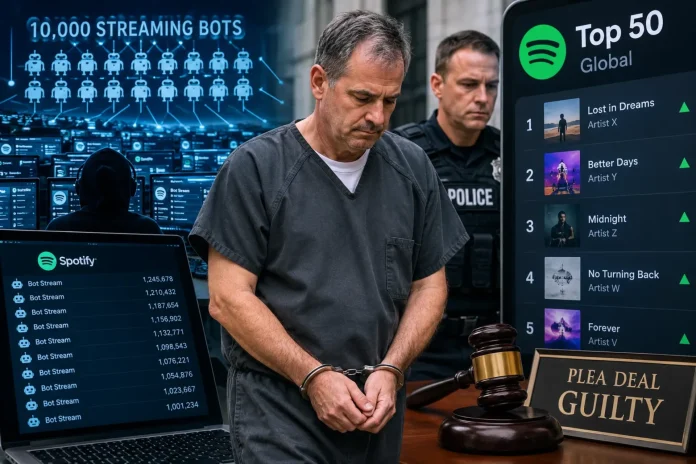
A North Carolina musician who used as many as 10,000 bot accounts and hundreds of thousands of AI-generated songs to siphon more than $8 million in streaming royalties has been sentenced to 18 months in federal prison.
Michael Smith, 54, of Cornelius, N.C., was sentenced Tuesday (Oct. 6) by U.S. District Judge John G. Koeltl in Manhattan federal court. In addition to the prison term, Smith will serve two years of supervised release and must forfeit $8,091,843.64 — the amount both sides agreed he collected through the scheme. The sentence comes after Smith pleaded guilty in March to one count of conspiracy to commit wire fraud, the first criminal case in the U.S. tied to AI-assisted streaming fraud.
According to the U.S. Attorney’s Office for the Southern District of New York, Smith’s operation ran from 2017 to 2024. He created thousands of fake accounts on Spotify, Apple Music, Amazon Music and YouTube Music using bulk-purchased email addresses under fictitious names and fraudulently obtained debit cards, often on family plans that allowed him to run large numbers of accounts more cheaply. Software then directed those accounts to stream songs he controlled nonstop.
To stay under the platforms’ radar, Smith spread the plays across a massive catalog rather than pumping up a few tracks. At its peak, prosecutors said, he had as many as 10,000 bot accounts running at once. In one internal email, he wrote that he needed “a TON of songs fast” to get around anti-fraud systems. That’s when he turned to artificial intelligence, generating hundreds of thousands of tracks that he uploaded under invented artist names. Some of his own original music was also in the mix.
The numbers were striking. In April 2023 alone, Smith’s bots racked up 80.9 million family-plan streams on YouTube Music. Taylor Swift’s entire catalog pulled just 9.3 million streams on the same platform and plan type that month. Overall, the accounts generated billions of plays, diverting royalties from the shared pools that pay real artists, songwriters and rights holders.
“Michael Smith exploited super intelligence technology to generate a fraud,” U.S. Attorney Jamie McDonald said in a statement. “By flooding music streaming platforms with automated bots in the place of consumers, and fake songs in the place of creativity, Smith robbed millions in royalty payments from genuine artists and their fans.”
Smith was first charged in September 2024. Federal sentencing guidelines called for 46 to 57 months; prosecutors asked for at least 46 months, while the Probation Office recommended 24. Smith’s lawyers sought probation, arguing he was “profoundly sorry” and that individual artists had not suffered “perceptible harm.”
In court, Smith told the judge he had “betrayed the music community I care so much about” and turned his love of music into a “perverse business model.” He added, “I have made a mess of what was an honorable life.”
The case has been closely watched by the industry as streaming fraud remains a persistent issue, especially with the rise of generative AI tools that make it easier to flood platforms with content. Groups working on the Streaming Integrity Initiative have pointed to the outcome as an important signal that artificial streaming will carry real consequences.