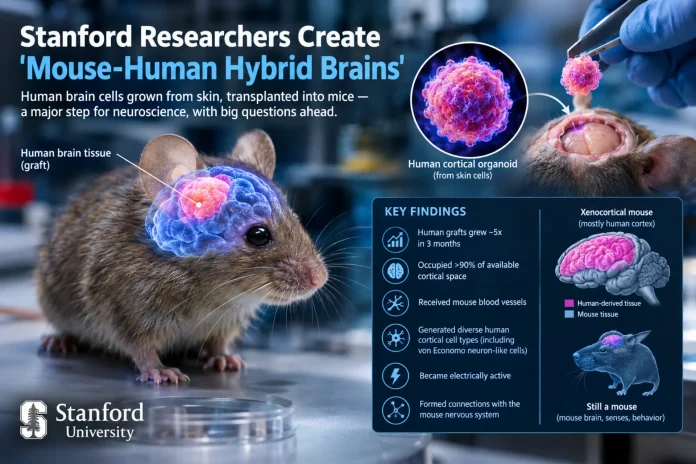
Social media exploded this week with claims that Stanford researchers built “mouse-human hybrid brains,” after a viral post described human brain tissue grown from skin cells and plugged into mice. The underlying science is real, but the framing needs context.
On September 16, 2026, a team led by Stanford neuroscientist Sergiu Pașca published findings in Nature under the title “Developmental xenocortication using human-derived organoids in mice.” Researchers genetically engineered newborn mice so most of their cerebral cortex and hippocampus failed to develop, creating open space in the brain. They then transplanted human cortical organoids three-dimensional clusters of brain cells made by reprogramming human skin cells into stem cells and guiding them into cortical tissue into that cavity.
Within about three months the human grafts expanded roughly fivefold, occupied more than 90 percent of the available cortical space in successful cases, received mouse blood vessels, generated diverse human cortical cell types (including rare von Economo neuron-like cells rarely seen in dish cultures), became electrically active, and formed connections with the mouse nervous system. Some human-derived projections reached the spinal cord. The animals, called xenocortical mice, showed partial improvement on certain memory and motor tests compared with mice that received no transplant, yet remained fundamentally mouse-like in behavior and overall nervous-system architecture.
Pașca has stressed the distinction: “The most important point is that these are still mice. They have a mouse nervous system, mouse sensory organs, and mouse subcortical structures. What is unusual is that most of the cortical tissue present in these animals is human-derived.” The work aims to create a living platform for studying human brain development and disorders such as autism, epilepsy, schizophrenia, and cerebral palsy conditions that dish-grown organoids and standard mouse models struggle to capture fully.
The advance offers a powerful new research tool, not science fiction. As coverage in outlets such as Reuters and Stanford Medicine makes clear, the model could help test how human neurons respond to injury or genetic changes inside a living system while raising legitimate questions about animal welfare and the limits of human-animal neural research that ethicists continue to debate.