

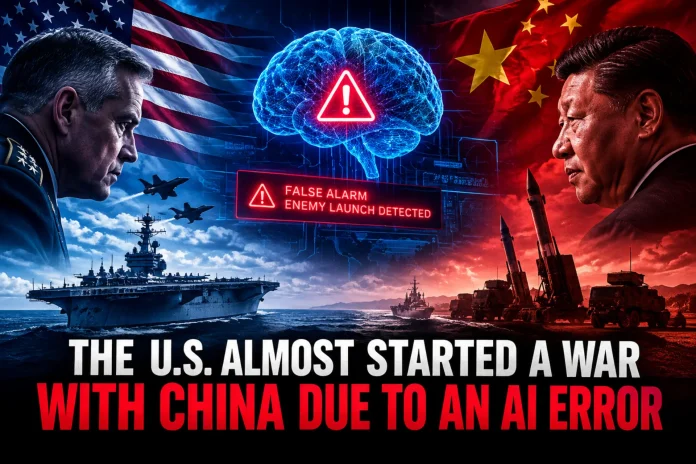
A false intelligence report generated with the help of an artificial intelligence chatbot nearly prompted the U.S. military to board a Chinese ship in the Middle East this spring, according to four sources familiar with the episode who spoke to CNN.
The report claimed the vessel was transporting components of a nuclear weapons program. Armed U.S. personnel prepared to board the ship while military aircraft were already in the air, the sources said. Officials discovered the error only moments before the planned operation and called it off.
One source described the report as “entirely false” and said the episode “almost started a war.” Any American action against a Chinese-flagged vessel risked escalating into armed conflict between the two nuclear-armed nations.
The incident unfolded amid the U.S. war with Iran. An analyst with U.S. Special Operations Command examined intelligence reporting on the ship’s manifest that originated with Special Operations Command Pacific in Hawaii. The analyst queried a chatbot about the material. The tool fused open-source intelligence with classified signals intelligence held by the government and incorrectly identified the cargo.
CNN could not determine what the ship was actually carrying. It also could not establish whether the chatbot was a commercial product or a government system. The analyst then used AI a second time to format the findings into a standard intelligence report of the type routinely trusted by military officials and circulated it across the force.
A former senior U.S. official familiar with the AI systems used by military and intelligence analysts said, “The internal tools are mostly just copies of the commercial stuff wearing lipstick.” U.S. Special Operations Command Pacific and the Pentagon did not respond to requests for comment.
The near-miss occurred as the Defense Department accelerated its adoption of artificial intelligence. In January, Defense Secretary Pete Hegseth released an Artificial Intelligence Acceleration Strategy aimed at putting leading U.S. AI models into the hands of military and civilian personnel at all classification levels. Hegseth said the department would “unleash experimentation, eliminate bureaucratic barriers, focus our investments and demonstrate the execution approach needed to ensure we lead in military AI.”
Officials argue that faster analysis is essential if the United States ever faces a peer adversary such as China. Yet the effort remains decentralized. Different commands use different tools under varying safety standards, and no uniform process exists for verifying AI-generated intelligence before it enters operational channels.
Sources told CNN that AI hallucinations of this kind have occurred elsewhere in the intelligence community since the tools proliferated across government. Younger analysts, in particular, tend to trust the systems more readily. “AI allows you to get to a bad idea faster,” one source said.
The episode illustrates a more immediate danger than long-term concerns about uncontrolled AI: human decision-makers acting on inaccurate or fabricated information produced by automated systems in the middle of a live conflict. The report first detailed in a CNN exclusive published September 18 underscores the gap between the speed of AI adoption and the slower work of establishing reliable verification practices.

