

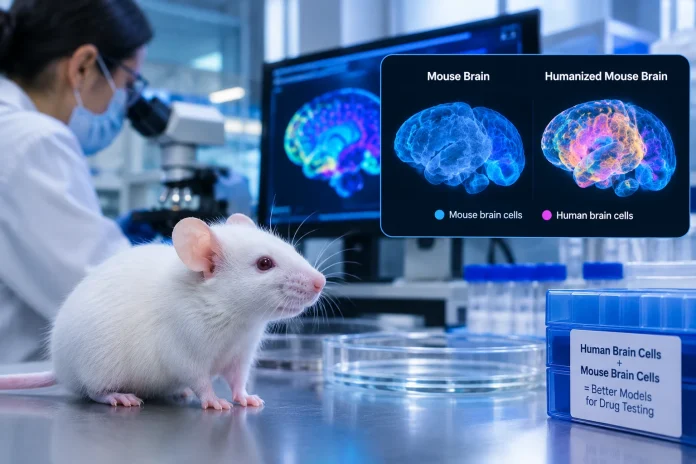
In a development that feels straight out of science fiction, researchers at Stanford have successfully created mice whose brains are partially human. The work, published this week in Nature, marks one of the most extensive integrations of human brain tissue into an animal ever achieved.
Scientists first genetically engineered mice so that most of the cells that would normally form the outer layer of the brain — the cortex — and the hippocampus never develop. These “apallial” mice are born with a large empty space where nearly half their brain should be. Surprisingly, they still survive, walk around, and function, though with some clear limitations in memory and coordination.
Into that empty space, the team transplanted tiny clusters of human brain cells known as cortical organoids. These organoids were grown in the lab from stem cells reprogrammed from human skin. Once inside the mice, the human tissue took over. Over the next few months it expanded, connected to the mouse blood supply, and wired itself into the remaining nervous system. By the three-month mark, more than 90 percent of the cortical tissue in these animals was human, making up roughly half the total brain volume.
The human cells yeahdidn’t just sit there. They generated a wide range of neuron types, including rare specialized cells called von Economo neurons that had never been successfully grown in a dish before. Some of the human neurons even sent projections all the way down into the spinal cord. Electrical recordings showed organized activity patterns that looked a lot like developing brain circuits.
Importantly, these are still mice. They have mouse sensory systems, mouse subcortical structures, and overall mouse behavior. Researchers are clear: these animals are not thinking like humans. But the human tissue did help restore some of the deficits seen in the cortex-less mice, particularly in memory and movement tests.
To show what the model can do, the team exposed the animals to low oxygen. The human tissue was far more vulnerable than the surrounding mouse brain, and the affected mice developed gait and balance problems that mirrored aspects of cerebral palsy. That kind of readout — linking human cell damage to measurable behavior — is exactly what scientists have been missing.
The potential here is significant. Conditions like schizophrenia, autism, epilepsy, and certain forms of dementia are notoriously hard to study because living human brain tissue is almost impossible to access. This new platform lets researchers grow patient-derived cells, place them in a living system, and watch how they develop and respond to potential treatments.
Ethical questions are already being raised, as expected with any human-animal chimera research. The Stanford team consulted ethicists and outside experts throughout the process. For now, the consensus is that the scientific upside is substantial, provided the work stays carefully bounded.

