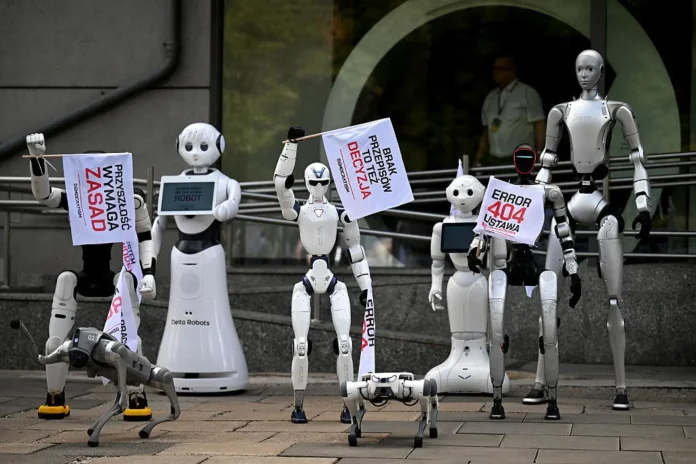
In a striking display that looked like a scene from a science-fiction film, around 30 robots gathered outside Poland’s Ministry of Digital Affairs in Warsaw, marching, waving flags and broadcasting demands for stronger regulation of artificial intelligence and greater protection for human jobs.
The unusual demonstration was organized by Democratism, a human-led initiative seeking to raise awareness about the potential effects of artificial intelligence and robotics on employment. Although images of the event made it appear as though robots themselves had organized a labor protest, the machines were deployed by human organizers as a symbolic warning about the technologies that could eventually replace workers.
The robots included humanoid and quadruped machines, which moved around the area in formation while displaying and broadcasting messages such as “Defend workplaces,” “Time for rules” and “Don’t wait, regulate.”
The organizers’ central argument was that governments need to establish safeguards before increasingly capable AI systems and robots become widespread enough to cause major disruptions in the labor market.
A protest about the future of work
Grzegorz Kuliś, one of the organizers, warned that the combination of artificial intelligence and advanced robotics could eventually affect a much wider range of occupations than earlier waves of automation.
Traditional industrial robots have largely been associated with manufacturing and repetitive physical tasks. Newer systems, however, are being developed alongside increasingly capable AI models, creating the possibility of machines performing not only physical work but also tasks involving information, analysis and other forms of cognitive labor.
That prospect has fueled concerns that automation could affect both factory workers and people in traditionally white-collar professions.
The Warsaw demonstration sought to bring that issue into public view through an intentionally ironic spectacle: robots were effectively protesting against the possibility of robots taking human jobs.
Digital Affairs Minister joins the discussion
The demonstration drew the attention of Krzysztof Gawkowski, Poland’s Deputy Prime Minister and Minister of Digital Affairs, who came outside to speak with the organizers.
Gawkowski acknowledged concerns about the rapid development of AI and robotics, particularly the prospect of increasingly sophisticated AI systems being integrated into humanoid robots.
The encounter highlighted a debate that is becoming increasingly important across Europe: how governments can encourage technological development while ensuring that workers and society are protected from potentially disruptive consequences.
The organizers argued that existing proposals may not go far enough in dealing with the potential impact of automation on employment.
Robots designed to make a point
According to reports, the robots used in the demonstration were supplied by Delta Robots, a company involved in developing humanoid and quadruped machines.
One of the machines showcased was reportedly an Agibot A3 humanoid robot, which was used to deliver messages about the need for regulation.
Their presence outside the ministry was as much a communication strategy as a political demonstration. The machines offered journalists and passersby a dramatic visual representation of a future that is normally discussed in abstract terms.
Rather than simply warning that “robots may take jobs someday,” the organizers placed functioning robots directly in front of the government institution responsible for digital policy.
A symbolic ‘robot revolt’
Despite descriptions of a “robot protest” or “robot revolt,” there was no autonomous uprising or independent decision-making by the machines.
The robots did not organize themselves, form a union or independently choose to demonstrate. Their movements and messages were part of an event arranged by people.
That distinction, however, was central to the demonstration’s message.
By putting robots at the center of a protest about employment, the organizers created a visual contradiction designed to attract attention to a serious economic question: what happens to workers when machines become capable of performing an increasing amount of human labor?
The demonstration therefore combined political advocacy with spectacle, using the machines themselves to represent a possible future of automation.
Why AI regulation is becoming a bigger issue
The Warsaw event comes as Poland and other European countries debate how artificial intelligence should be governed and incorporated into their economies.
AI is already being introduced into areas ranging from manufacturing and administration to customer service, software development, research and creative work. At the same time, advances in robotics are making it possible to place AI systems inside physical machines that can operate in environments designed for humans.
That combination could allow automation to expand beyond factories and warehouses into offices, homes and other workplaces.
Supporters of regulation argue that workers may need new forms of protection, including retraining opportunities, stronger labor safeguards and policies designed to ensure that productivity gains from automation do not come at the expense of large numbers of jobs.
The question governments face
The Warsaw protest ultimately raised a question much larger than the spectacle itself: how should governments prepare for a labor market in which machines can increasingly perform both physical and intellectual tasks?
The debate is no longer limited to whether robots should be allowed to operate in factories. It now concerns the broader economic consequences of increasingly capable AI systems, including who benefits from automation and how displaced workers will be supported.
The organizers behind the Warsaw demonstration argue that those questions should be addressed before technological change accelerates beyond the ability of policymakers to respond.
For now, the sight of dozens of robots marching outside Poland’s Ministry of Digital Affairs may have been unusual, even humorous. But the message behind the demonstration was serious.
The machines were not demanding rights for themselves. They were being used to warn humans about a future in which machines could fundamentally change the meaning of work.