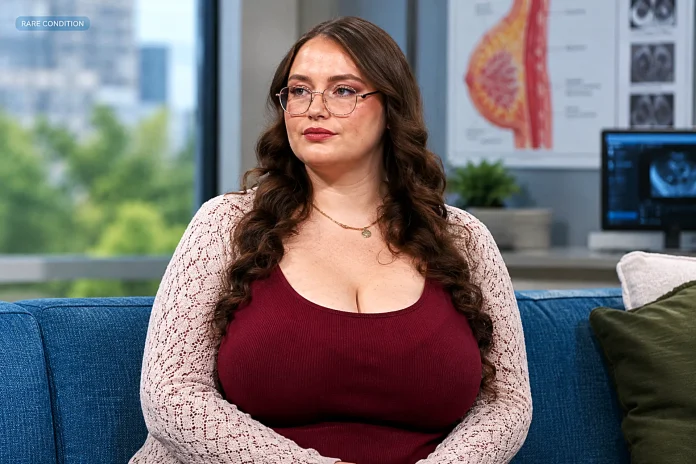
Summer Robert, a 28-year-old from Glasgow, Scotland, lives with macromastia, a rare condition that causes continuous and excessive growth of breast tissue. Her breasts currently measure a 30U bra size and weigh approximately 27 kilograms, or nearly 60 pounds, according to her appearance this week on ITV’s This Morning.
Robert sat down with hosts Cat Deeley and Ben Shephard on the September 7 episode of the long-running daytime show. To put the weight in context, the presenters lifted two water-cooler bottles totaling the same amount. Standing about 4 feet 11 inches tall, Robert said she carries that load every day and has largely adapted to it, though seeing the demonstration made the scale real.
“I don’t really think it’s that bad, because I do it every single day,”
she told the hosts.
“But when I saw you try and lift it, I was like, damn. Seeing it is really crazy.”
Development began unusually early. Robert said her breasts started growing around age 7 when hormones kicked in, and she got her period at 8. She was the first among her friends to develop. Raised primarily by her father, she had limited support at home. Doctors throughout her teenage years attributed the size to puberty and advised weight loss, even as she sought breast reduction surgery starting at 14.
“I was at the doctors like throughout all of my teens constantly, and they would just all say it was like puberty,”
Robert said on the show. She tried to get reductions starting at 14. Each time, she recalled, clinicians told her her BMI was too high because her breasts weighed so much, and the explanation she got back was that she was overweight. Her point: the weight was the breasts itself.
She is far from alone in navigating the surgical route. Sydney Sweeney has spoken about almost getting a breast reduction in high school, a familiar early-adulthood decision point for women whose breast size interferes with daily life. A formal diagnosis of macromastia came only about four years ago in the UK, with further details from specialists in the United States confirming the hormonal basis. At age 25 she experienced another rapid growth phase, increasing 11 bra sizes in a single year. The condition is also known as gigantomastia or breast hypertrophy. There is no cure that stops the growth, and reduction surgery carries a high likelihood of regrowth, according to medical literature on the condition.
The physical effects are daily and cumulative. Robert has chronic back, neck and shoulder pain, difficulty sleeping, and limited mobility for everyday tasks. She needs specialized support garments, and finding clothes and bras that fit is its own problem; she imports custom bras because her size is not readily available in UK retail. The annual cost is significant. She has estimated it at more than £125,000 a year, a figure that includes custom garments, mobility support, and lost work.
On the public side, NHS clinicians have repeatedly declined reduction surgery, citing elevated BMI driven largely by breast weight and the expectation that tissue would return. According to Glasgow Live, Robert has spent about a decade asking for the procedure and being told no each time. Specialists later said surgery would not permanently halt the growth. That complicates any decision either way. She previously worked in hospitality as a restaurant manager and bartender, where the physical demands and unwanted attention were significant.
The clinical picture is consistent with the medical literature. Macromastia is typically defined as excessive breast growth that requires reduction of more than 1.5 kilograms per breast, or that causes significant physical symptoms. It is uncommon. The most extreme congenital forms appear in roughly 1 in 28,000 to 1 in 100,000 births. Puberty-onset and hormone-onset cases are documented but harder to count. Diagnosis is clinical, with hormone panels and imaging used to rule out other causes.
Policy is part of why her case has run aground. The gap between UK and US approaches shapes what is available to her. NHS England’s commissioning criteria for breast reduction require documented physical symptoms, a BMI threshold, and a minimum tissue weight to be removed, and they treat recurrent cases with caution. US insurers vary more widely. Robert’s situation sits at the seam between the two systems: the UK rule set declined her, and a US consultation did not change the underlying diagnosis.
In recent years she has built a career as an adult content creator on OnlyFans, operating under the handle associated with her public Instagram account, scotchdolly97, where she has drawn a substantial following and income by sharing aspects of her life with the condition. Her Instagram following crossed 359,000 in mid-August, according to her profile. She has spoken publicly about moving from earlier feelings of isolation and objectification toward greater acceptance of her body. The financial turn in her work mirrors a broader shift across the platform; Bonnie Blue’s 1,000-man feat and her OnlyFans ban is one recent marker of where the platform’s content limits are being drawn.
Macromastia remains uncommon. Growth can accelerate during periods of hormonal change such as puberty, pregnancy, or hormonal medication. Robert continues to manage the daily realities of the condition while appearing in media interviews that have brought wider attention to a treatment landscape that, for the most severe cases, still offers limited permanent options. The wider media appetite for these stories is also visible in adjacent coverage, from a UK influencer’s hospital-bed dance for a dying man’s will to UK-based wellness stories like the woman who got her late dog’s ashes tattooed into her eyeliner. Robert’s case sits at the intersection of medical and viral attention, a position she has chosen to use to make the condition harder to ignore.