Local outlets had the chase on June 8. The international audience caught it this week. On Tuesday, Sept. 1, 2026, the news account NEXTA repackaged the sheriff’s body-camera footage with a global caption: “Alligator helps police catch fugitive in the US. 40-year-old Victor Rivas tried to hide from police in a Louisiana swamp. But an alligator attacked him in the water and bit his hands. Rivas continued trying to flee anyway, but police soon found him using a drone.” That repost — 139 favorites in the first hours — is what put the phrase “Deputy Al E. Gator” into English-language feeds worldwide. Hypefresh’s first report on the chase ran in June. The legal-record map is what cleared up this week.
On Sunday, June 7, 2026, Louisiana State Police Troop B troopers pulled over a Toyota Supra that had been driven recklessly on Interstate 10 near Bonnabel Boulevard in Jefferson Parish. The car had already struck a concrete barrier and blown a tire. Troopers located the Supra traveling south on I-310 in St. Charles Parish and stopped the driver, identified as 40-year-old Victor M. Rivas, of 160 Westover Lane in Montz. Troopers observed signs of impairment. Before they could finish the on-scene DWI investigation, Rivas ran and jumped from the elevated roadway into the swamp below.
Troopers and St. Charles Parish Sheriff’s Office deputies started looking. They later spotted Rivas walking along U.S. Highway 61, also known as Airline Highway. When officers moved in, he ran into another stretch of swamp.
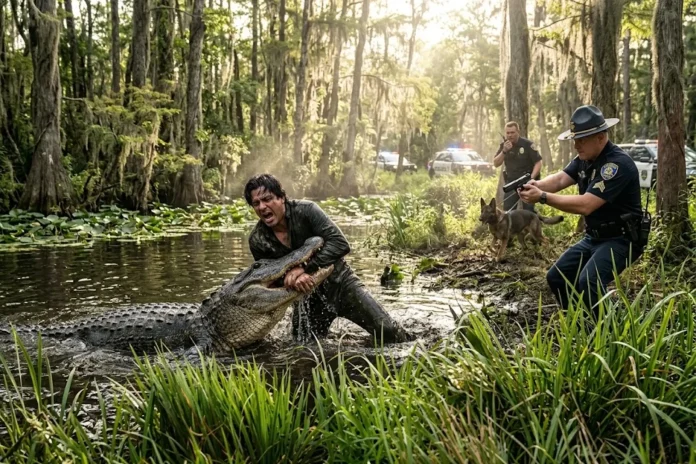
That is where the alligator got him. Body-camera video released by the office shows the gator closing in through grassy water near the bank and Rivas taking bites to both arms before he kept moving. Officials described the injuries as obvious once Rivas came out: both arms showed the encounter.
“He entered the swamp, and while he was swimming across the canal, he was attacked by an alligator,”
Louisiana State Police Trooper Kyle Wagner said. Wagner added that the suspect was able to fend off the animal and continued his attempt to evade law enforcement,
“but we eventually were able to bring him in with the help of a drone.”
Wagner told reporters the deputies
“had to wait for him to pop out the woodline to make that apprehension.”
Drone operators radioed ground units as Rivas left the swamp. Deputies took him into custody there. He went to a hospital first. The sheriff’s office said the alligator was unhurt and “has since returned to its regular patrol of the swamp.” Hypefresh readers will recognize the drone-track pattern from the Sacramento police disarming a suspect with a drone earlier this year, and the DWI-arrest-then-department-PR-honors beat from the officer who arrested Justin Timberlake for DWI getting “Officer of the Year”.
After treatment, Rivas was booked at the Nelson Coleman Correctional Center on charges of operating a vehicle while impaired, first offense, and resisting an officer, per a June 8 news release from Sgt. Jenni Barrette, the sheriff’s public information officer. State police said additional warrants were obtained in Jefferson Parish for hit-and-run and careless operation tied to the earlier crash. Herald Guide reported a $17,500 bond. No attorney of record was named in initial filings.
Under Louisiana’s first-offense OWI statute, La. R.S. 14:98, a conviction on the DWI count alone carries a fine of $300 to $1,000 and a sentence that can range from 10 days to six months, plus court costs and a statutory surcharge. The resisting-an-officer count, under La. R.S. 14:108, is independent and carries its own penalties. Both are allegations until a court rules. Hypefresh’s prior coverage of impaired-driving arrests includes the Prince George man’s pink-Barbie-Jeep arrest, which carried a different outcome because it stopped in a parking lot rather than at a swap-and-run on a Louisiana interstate.
Sheriff Greg Champagne’s office turned the gator cameo into a public-affairs move. Louisiana Radio Network reported the office posted an AI image showing Champagne presenting a “Deputy of the Year” plaque to a uniformed alligator labeled “Deputy Al E. Gator.” The office also posted a public warning to its social channels: “Don’t drive impaired, don’t run from deputies, and definitely don’t hide in Louisiana swamps. Wildlife may just be cooperating with law enforcement.”
The chase started in Jefferson Parish, west of New Orleans, and ended in the wetlands under and around I-310 in St. Charles Parish. The highways there sit on low bridges over marsh for long stretches, and the bayous running under them are a normal habitat for American alligators. The species has been federally protected as Threatened under the Endangered Species Act — classified “due to similarity of appearance” to the American crocodile — since the early 1970s and remains on the protected list. Jumping off an elevated interstate into a marsh that day put Rivas into water the alligator was already using. The presence of deputies did not slow the gator down.
None of the local wire outlets — Herald Guide, KEDM, WBRZ, or the Louisiana Radio Network — reported a court date in the days after the arrest. Yahoo’s syndication of NBC News’ first-week write-up also stopped at the booking record. The September second-wave viral moment that NEXTA’s X clip set off centered on the gator cameo, not the docket, and feeds of the chase’s first-week coverage circulated again worldwide this week. Hypefresh will update this article when a court date or plea is on the public record.
The sequence on paper is: reckless-driving reports on I-10, a damaged Supra found on I-310, a foot flight off the elevated roadway, a second flight from Airline Highway into a canal, an alligator bite, the drone fix, the hospital, the booking.