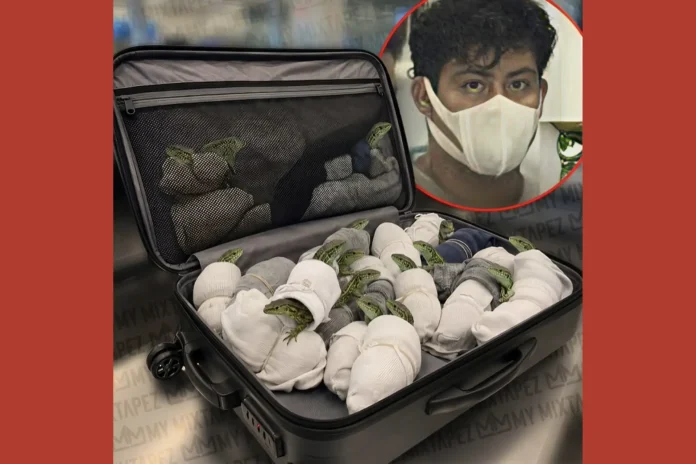
Customs officials in Tokyo’s Haneda Airport have discovered something astonishing in the passenger’s bag on August 8, 2026 approximately two hundred lizards found stuffed in twenty-two pairs of socks and one T-shirt. The man, twenty-three-year-old Mexican named Daniel Isaac Velasco Baltazar, arrived on a flight from South Korea. One of the lizards was already dead, according to the source.
The Tokyo Metropolitan Police Department received an anonymous tip about the smuggling of reptiles to Japan in late July. Authorities said there was an intention to deliver exotic animals for the upcoming reptile exhibition, so Tokyo Customs officers searched the luggage of arriving passengers. The police found a suspicious package in the man’s bags and opened it twenty-two pairs of socks with dozens of lizards and one T-shirt, in which one of the reptiles had died. Baltazar faces allegations of violating Japan’s Customs Act by attempting to import the animals without declaration or required permits. He has admitted the basic facts, telling investigators,
“There is no mistake in the facts.”
His residence and occupation remain listed as unknown.
Among the roughly 200 lizards of various species were nine Mexican alligator lizards, also known as green arboreal alligator lizards (Abronia graminea). These highland species, native to Mexico’s Sierra Madre pine-oak and cloud forests, are regulated under the Convention on International Trade in Endangered Species of Wild Fauna and Flora (CITES). International commercial trade requires export permits from the country of origin. Japan enforces those rules strictly; unauthorized import is illegal.
Baltazar told police he purchased the reptiles in Mexico for about ¥560 to ¥750 each roughly $3.50 to $5. In Japan’s exotic-pet market, rarer specimens such as the alligator lizards can command around ¥100,000, or about $600–$630, according to reports. Authorities have not established market values for every animal in the shipment, so no total profit figure can be assumed. The large markup between source and destination markets is what drives much of the illicit trade.
The concealment method itself raises clear animal-welfare concerns. Live reptiles crammed into socks and clothing face extreme stress, risk of injury, dehydration, and death. The discovery of at least one dead lizard underscores those risks. Conservationists note that demand for exotic pets, combined with habitat pressures in source countries, continues to incentivize trafficking of regulated species.