Elon Musk just put a hard date on the future of artificial intelligence, and it doesn’t involve more power plants or another round of zoning fights.
In a post on X Friday, the SpaceX and xAI CEO said orbital compute “will be the only way to scale AI probably sometime in 2029 due to power availability & permitting problems on land.” The comment landed amid growing chatter that space-based data centers are shifting from sci-fi side project to the only realistic path forward if AI is going to keep expanding at its current pace.
Musk’s argument is straightforward. The hunger for computing power is no longer limited to chatbots and recommendation engines. Autonomous vehicles, humanoid robots, scientific simulation, and materials research are all competing for the same electricity and the same scarce real estate. Building new generation capacity takes years. Getting permits for large data centers has become a slog of environmental reviews, water restrictions, noise complaints, and local pushback. By the end of the decade, he believes those bottlenecks will make further major expansion on Earth nearly impossible.
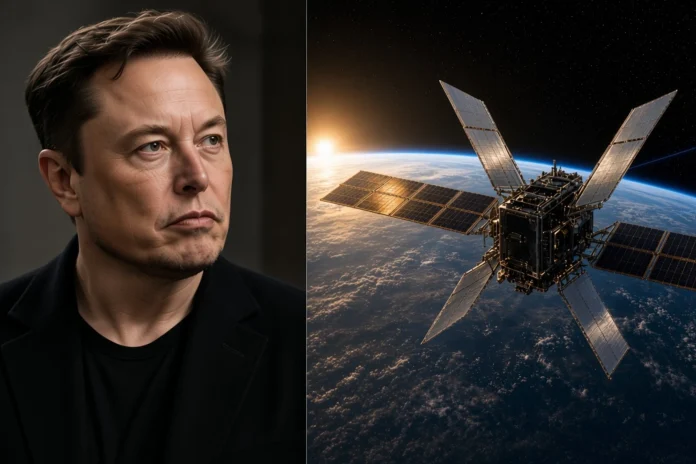
SpaceX has spent the past year turning that diagnosis into hardware. The company has already filed with the FCC for a constellation of up to one million AI-focused satellites. The first generation—called AI1 or Starmind—is essentially a server rack wrapped in solar panels and radiators. Fully deployed, each satellite stretches about 70 meters across, wider than a Boeing 747. Early designs targeted 150 kilowatts at peak; Musk later raised the numbers to roughly 250 kilowatts peak and 160-plus kilowatts average so the satellites can run next-generation Nvidia systems.
Cooling is the real engineering puzzle. In the vacuum of space there’s no air or water to carry heat away. The only option is to radiate it out as infrared energy, which requires large, carefully angled radiator surfaces. SpaceX says much of the technology already exists in its latest Starlink satellites, so the AI versions should actually be simpler in some ways—they don’t need the complicated antennas required for consumer internet.
Latency from low Earth orbit sits in the low single-digit milliseconds, fine for most inference work. Data can hop between satellites over laser links and reach the ground through the existing Starlink network. Radiation hardening, long-term reliability, and the sheer number of Starship launches required for real scale remain open questions. Analysts have pointed out that the economics only work if launch costs and satellite manufacturing drop far enough to undercut the rising price of power and land on Earth.
SpaceX is moving fast on paper. Demonstrators are targeted for late 2027, with the first operational birds possibly flying in 2028. Musk has talked about reaching an annualized gigawatt of orbital AI compute by the end of next year and then scaling aggressively from there. The company is already renting terrestrial AI capacity to major players, so the orbital systems are being positioned as the next chapter of an existing business rather than a pure moonshot.
Whether 2029 really becomes the tipping point will depend on how tightly the ground-side constraints squeeze and how quickly the space hardware can be proven at volume. What’s clear is that the conversation has left the realm of speculation. Musk is treating Earth’s power and permitting problems as a hard ceiling—and he’s betting the only way over it is straight up.