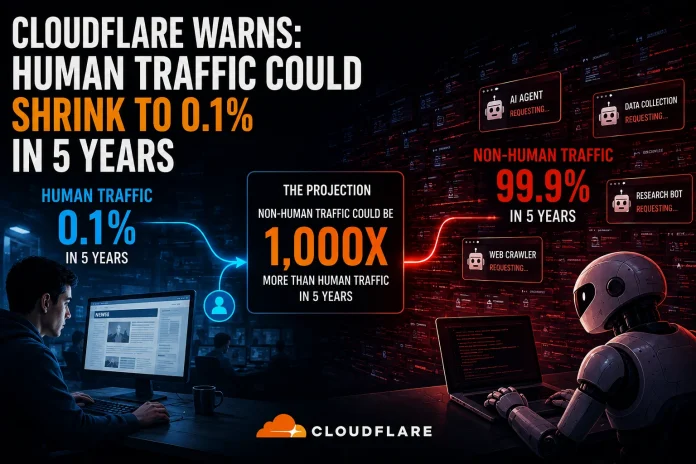
Cloudflare just dropped a number that should make anyone who makes a living online sit up straight. In five years, human traffic could shrink to roughly one-tenth of one percent of everything hitting the web.
That projection came from Cloudflare CFO Thomas Seifert on the company’s second-quarter earnings call. “If the current trends continue, we think in five years, non-human traffic will be as much as 1,000 times as much as human traffic,” he said. “In other words, humans will be a rounding error on the internet, not because human traffic goes down, but that’s just how fast we’re seeing non-human traffic grow.”
He threw in the usual hedge that he’s been wrong on timing before. Still, the raw math is hard to ignore.
The crossover already happened. By May and June of this year, Cloudflare’s Radar data showed bots pulling ahead of people for the first time, landing at about 57 percent of HTTP requests for page content versus 43 percent from actual users. CEO Matthew Prince had been telling rooms full of people it wouldn’t land until late 2027, then revised it to early 2027. When the numbers flipped early, he posted the only reaction that fit: “Welp, that happened faster than I predicted.”
What’s driving it isn’t the old scrapers and spam bots that have always been around. It’s the new wave of agentic systems that go out and do things for you. You tell an AI you need a new camera or a flight to Miami or research on a label deal, and it starts hitting thousands of pages while you’re still finishing your coffee. One person generates a handful of requests. One agent can generate thousands. Scale that across the entire user base and the pipes fill up fast.
Cloudflare sees a big slice of the public web, so its numbers carry weight even if they don’t cover every last server on the planet. The company is measuring requests, not time spent staring at screens or scrolling feeds. People still own the hours. Machines now own the volume.
For anyone whose business depends on attention, the shift is already forcing new conversations. Publishers are looking at higher server bills from traffic that doesn’t click ads or subscribe. Cloudflare has been testing tools that let sites charge the bots that crawl them while keeping the door open for real visitors. Prince has said out loud that the future might look like free content for humans and a toll booth for everything else.
Seifert’s forecast is just that, a forecast. Growth rates can change. New rules and pricing models can slow the flood. But the direction is clear enough that the internet’s original design assumption, the idea that a person sits behind most of the clicks, is already looking outdated on one of the largest networks in the world.