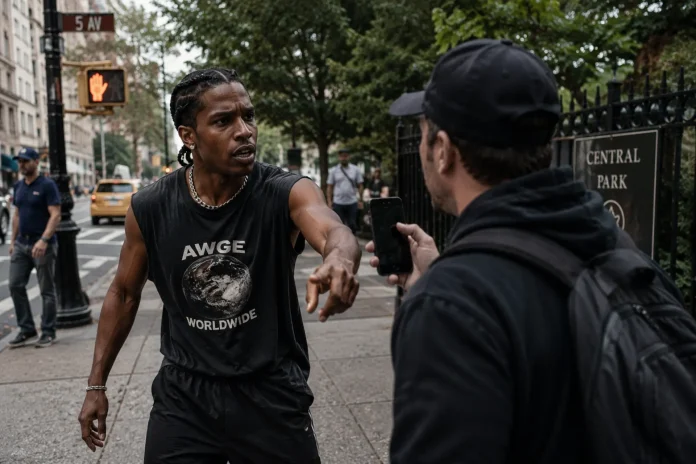
A$AP Rocky stopped mid-stride on a busy SoHo sidewalk in New York City and confronted a man who had been trailing him with a camera during a morning jog, demanding that the filming end immediately. The rapper grew frustrated after realizing the individual continued recording despite clear awareness of the intrusion into a private workout. Video captures Rocky in a black Puma tank top, black shorts, white socks and vivid red sneakers as he turns fully toward the camera operator under natural daylight filtered through the leaves of nearby trees. Parked cars, including a white utility vehicle, and distant pedestrians form the urban backdrop while city traffic provides steady ambient noise.
Rocky first asks what the man is doing, then presses whether he is following him, and repeats the question with the word “brother” for emphasis. He shifts to a greeting: “How are you doing, brother?” before demanding to know the reason for the pursuit multiple times in quick succession. The exchange intensifies as Rocky observes that the filming has not stopped and questions whether the goal is simply to obtain a clip of the moment. His expression shows furrowed brows, tightly focused eyes and direct, intense eye contact that conveys controlled irritation without raising his voice to a shout.
In the closing moments, Rocky states that he runs a company called Photography Club and affirms respect for the work involved, yet still requires the camera to be lowered so they can speak directly as people. He concludes by instructing the man to take the camera down and talk to him, “brother,” while maintaining an open stance and steady gaze. The roughly 26-second recording spread rapidly across platforms after first appearing on July 23 and continuing into July 24. The sequence illustrates how continuous documentation during ordinary exercise can provoke a measured but firm response from someone accustomed to public attention.
Known professionally as A$AP Rocky and formally as Rakim Athelston Mayers, the artist has long pursued fitness routines in his native city while managing a career that spans music, fashion and creative direction. Details of his background and achievements appear in comprehensive profiles that outline his rise with the A$AP Mob and later independent projects. Financial assessments place his resources at thirty million dollars, reflecting earnings from recordings, tours and brand work. He is the partner of Rihanna and father of their children, and he often moves through neighborhoods without heavy security, which leaves room for unplanned interactions like this one.
The confrontation highlights the friction that arises when persistent recording overrides basic expectations of space during daily activities. Rocky’s choice to engage verbally rather than ignore the situation or escalate physically demonstrates a preference for clear boundaries delivered with composure. Such moments serve as practical examples of how public figures and ordinary residents alike can assert limits in an age of constant documentation. Respectful dialogue remains a workable alternative that reduces tension while preserving the ability of individuals to complete simple tasks like a jog without interruption.