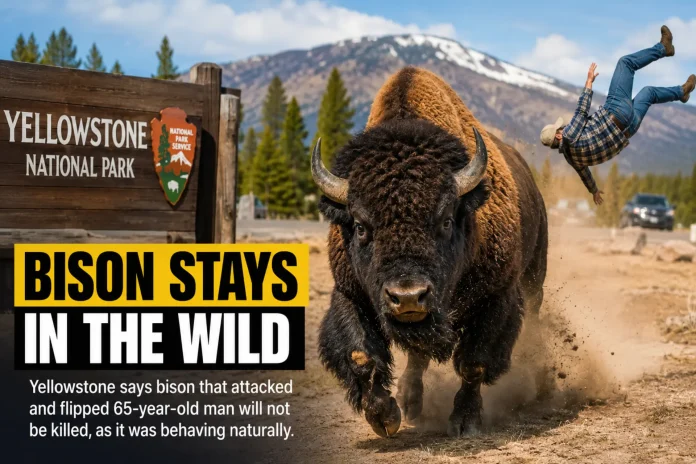
Yellowstone National Park officials have decided against euthanizing the bull bison that tossed a 65-year-old Washington man into the air during a campground encounter last week.
Yellowstone National Park (Wyoming, Montana, Idaho) officials have confirmed that the bull bison acted in accordance with its natural instincts when it charged Carl Isom-McDaniel at Bridge Bay Campground near Yellowstone Lake on the evening of July 10 around 8:30 p.m. Mountain Daylight Time. Park staff confirmed the bison will remain in the wild with no management intervention planned. Isom-McDaniel, a 65-year-old grandfather from Washington State, suffered a broken femur in multiple places along with additional injuries, but has undergone surgery and begun standing again while recovering, according to local news reports. The encounter unfolded after the bull bison appeared calm, then became agitated, possibly by a passing truck, before pursuing the man and his grandson around a cluster of pine trees.
Witness accounts describe the bull bison as visibly agitated before the incident. It had already charged at other campers, including a group of teenagers, earlier that evening. Isom-McDaniel and his 13-year-old grandson had paused to take photos from a distance before the animal pursued them around a cluster of trees. The bison hooked the man near the hip and launched him roughly 8 feet into the air. Bystanders, including professional photographer Mike MacLeod, intervened by yelling and approaching to drive the animal away until park emergency responders arrived about 10 minutes later.
National Park Service guidelines consistently remind visitors to maintain at least 25 yards from bison and recognize signs of agitation, such as head bobbing or raised tails. Bison rank as the leading cause of injuries to park visitors because of their size, speed, and power, especially during the summer rut when testosterone levels rise. This event marks the second reported bison-related injury in Yellowstone this year, following an incident in late June in which a 12-year-old visitor was hospitalized after a bison encounter near Mud Volcano. The injuries underscore the need for constant awareness around wild animals that can weigh up to 2,000 pounds and outrun humans.
Park officials reached the decision to take no action against the bison after reviewing the incident and determining it behaved naturally within its habitat. This determination came from Yellowstone National Park staff, who prioritize wildlife protection alongside public safety. Officials emphasize that bison remain free-roaming symbols of the American West, rather than managed threats, unless they pose repeated risks. This approach aligns with broader conservation efforts to protect one of the last significant wild herds in the United States.
The incident has renewed conversations about responsible tourism in national parks, where natural encounters carry inherent dangers. Visitors bear primary responsibility for safety by respecting posted distances and heeding warnings during peak seasons. Isom-McDaniel himself later noted the bison could have caused far worse harm while he lay on the ground, yet chose not to press the attack further.
For official safety recommendations, see the Yellowstone National Park bison guidelines. Details on the park response appear through Yellowstone Public Affairs statements. Background on the victim community contributions comes from local profiles. Additional wildlife encounter data is available via National Park Service visitor safety resources.