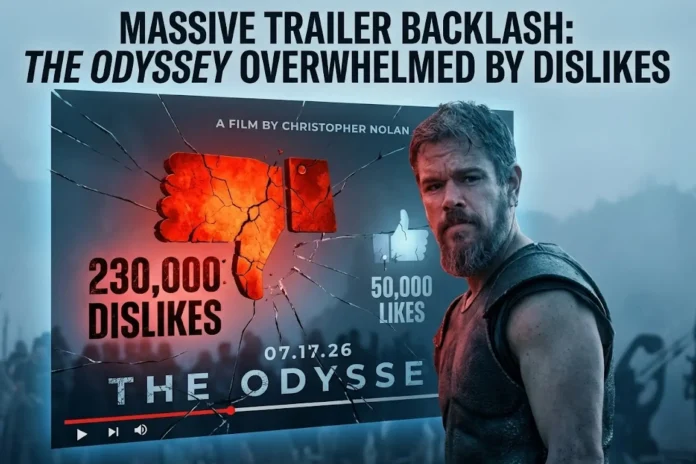
The final countdown trailer for Christopher Nolan’s adaptation of Homer’s The Odyssey has quickly drawn intense online scrutiny, racking up roughly 230,000 dislikes against 50,000 likes on the Universal Pictures YouTube channel within days of its July 1 release. The two-and-a-half-minute video highlights sweeping IMAX footage of ancient settings, sea voyages, and key cast members, yet it has become a focal point for criticism rather than pure excitement. This lopsided response comes just weeks before the film’s wide theatrical debut on July 17, 2026, and reflects deeper conversations about how classic stories translate to modern cinema.
The movie centers on Odysseus, portrayed by Matt Damon, as he navigates a perilous decade-long journey home to Ithaca after the Trojan War. Along the way he encounters mythical challenges including the one-eyed Cyclops Polyphemus, the seductive Sirens, the nymph Calypso, and interventions from gods and goddesses. Nolan’s version emphasizes practical effects, real-world locations across multiple countries, and large-scale action shot entirely on IMAX 70mm film for the first time in his career. The story blends epic adventure with human drama as Odysseus fights to reunite with his wife Penelope, played by Anne Hathaway, while their son Telemachus, portrayed by Tom Holland, deals with suitors back home. Production details list a budget around 250 million dollars and highlight an ensemble that also includes Zendaya as Athena and Lupita Nyong’o in the role of Helen of Troy.
When the first official looks and earlier trailers appeared months ago, audience impressions leaned strongly positive and generated significant hype. Fans praised the ambitious scale, the prestige of the cast, and the promise of Nolan’s signature visual style combined with IMAX presentation. Comments often described the early footage as potential “absolute cinema” and expressed excitement for a fresh take on a foundational story. Those initial releases focused more on broad spectacle, star power, and technical innovation without triggering widespread pushback at the time.
The surge in dislikes with this latest trailer stems largely from its timing and content emphasis closer to release. As casting specifics became more widely discussed and visible in the new footage, long-simmering concerns gained traction and translated into direct platform voting. The video arrived after months of online conversations about representation, allowing existing debates to intensify rapidly. Viewers who had been following production details reacted more strongly once the countdown trailer made certain creative decisions feel more concrete and imminent.
People are primarily voicing frustration over casting choices that some feel depart from traditional depictions in the ancient Greek source material. In particular, the selection of Lupita Nyong’o as Helen of Troy has drawn criticism from those who view the character as historically or mythologically associated with fair-skinned Greek beauty. Additional comments target Zendaya’s portrayal of the goddess Athena and question whether diverse casting aligns with expectations for fidelity to Homer’s epic. A smaller number of reactions also mention dialogue or tone that feels contemporary rather than rooted in classical storytelling. These points have dominated the visible feedback rather than broad rejection of the visuals or action sequences themselves.
The heavy dislike ratio does not necessarily signal that most audiences have already rejected the finished film. Trailer reactions often capture immediate responses to specific creative elements, especially in an era of polarized cultural discussions around adaptation and representation. Many viewers appear divided between those who prioritize strict alignment with traditional mythological interpretations and those who support Nolan’s vision for a more inclusive or reimagined approach to timeless stories. Nolan has a strong history of delivering technically ambitious films that perform well despite pre-release debate, suggesting the numbers reflect targeted dissatisfaction rather than outright dismissal of the overall project.
Additional production context shows the film was produced by Nolan and his longtime collaborator Emma Thomas through their Syncopy banner, with executive producer Thomas Hayslip. Filming took place across diverse real-world locations to achieve authenticity, and the emphasis remains on practical effects over heavy reliance on computer-generated imagery. The official movie website and trailer remain available for direct viewing, while the project continues preparations for advance screenings ahead of its July 17 opening. Broader conversations around the trailer underscore ongoing industry questions about balancing source-material respect with contemporary casting practices in high-profile epics.