

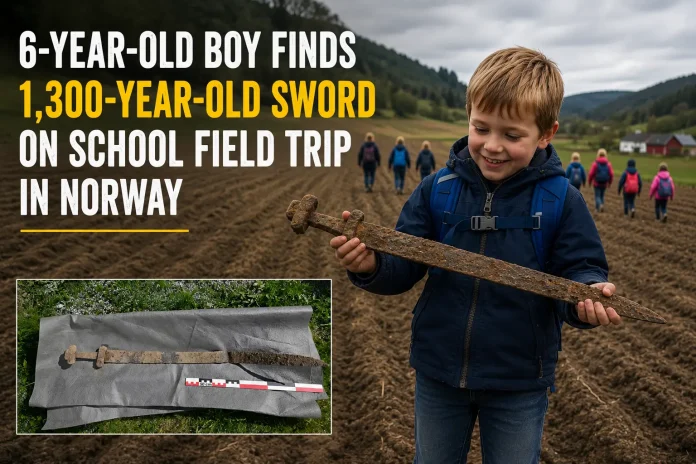
A routine school field trip turned into an extraordinary archaeological moment when six-year-old Henrik Refsnes Mørtvedt pulled a remarkably preserved 1,300-year-old sword from a plowed field in Norway.
The first-grader from Fredheim School was walking across farmland in the Brandbu/Tingelstad area of Gran municipality, in the historic Hadeland region of Innlandet county, when he noticed a rusty object sticking out of the soil in late April 2026. Thinking it was nothing more than scrap metal, the boy reached down and tugged it free.
“This part was sticking out. It was rust and soil. So I thought I would pick it up and see what it was,” Henrik said in a translated statement.
His teachers immediately recognized the potential significance of the find and alerted archaeologists from Kulturarv i Innlandet. Experts later confirmed it as a rare single-edged iron sword dating back to around 800–850 CE, placing it in the late Merovingian Period — also known as the Vendel Period in Scandinavia — and the very beginning of the Viking Age.
Measuring approximately 95.5 cm (37.6 inches) long, the sword features a bent blade, likely the result of a ritual “killing” before it was buried with its owner more than 1,200 years ago. Its style is consistent with early Scandinavian craftsmanship, resembling Jan Petersen’s Type F swords. Despite heavy corrosion, the artifact is considered exceptionally well-preserved.
Hadeland, long nicknamed the “Land of the Warrior,” is known for its rich concentration of Iron Age and Viking-era burial mounds and archaeological sites, making the discovery especially fitting for the area. Authorities believe the sword most likely came from a disturbed grave.
The artifact has been transferred to the Museum of Cultural History in Oslo, where conservators will clean, X-ray, and study it further. Henrik and his class are being praised for following proper procedure, and the young finder will receive a finder’s fee as mandated by Norwegian cultural heritage law. He is also expected to see his discovery on public display at the museum in the future.
While children occasionally stumble upon historical items, discoveries of this magnitude and age are exceptionally rare. The story has quickly gone viral in Norway and internationally, with many dubbing the six-year-old a “future archaeologist.”
