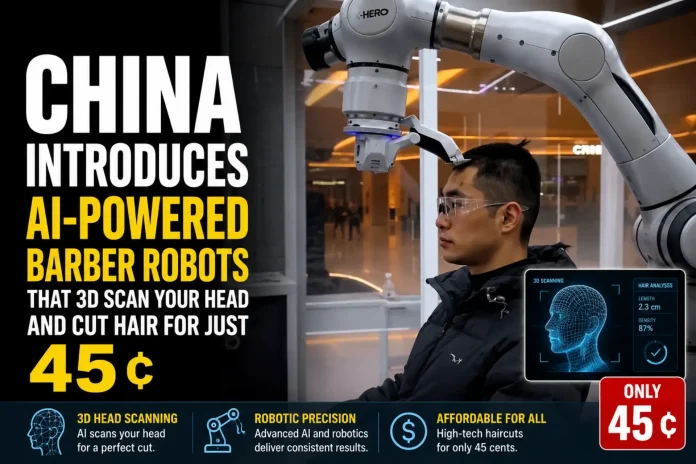
China is rolling out AI-powered robotic barber kiosks that scan heads in three dimensions and deliver haircuts for the equivalent of about 45 cents, a sharp contrast to what many men in the United States typically spend on grooming each year. These automated stations use advanced 3D imaging and artificial intelligence to map facial structure, hair texture, and density. A robotic arm then executes precise trims with millimeter-level accuracy. Customers simply pick a style on a touchscreen, sit back, and let the machine handle the rest in compact public kiosks found mostly in shopping centers around cities like Shenzhen. The systems come equipped with safety sensors that protect sensitive areas like ears and the scalp, focusing on everyday cuts such as fades and buzz styles.
The technology tackles real issues in China’s service industry, such as climbing labor costs and a shortage of skilled barbers in busy urban spots. With no staff to pay and everything contained in a single unit, the kiosks keep overhead extremely low, which is how they can charge just 3 yuan per session. Engineers built in computer vision, pressure sensors, and real-time adjustments so each cut stays consistent. This push reflects China’s bigger drive to weave robotics into everyday consumer life for greater efficiency and accessibility.
Meanwhile, men in the United States often pay much more for traditional barber services. Depending on the city and stylist, a single haircut can run between $35 and $43. Many guys go every couple of weeks, and when you factor in premium products, shop rent, and that personal conversation, the yearly total easily climbs into the hundreds for regular clients. These gaps show two very different economic approaches: one leaning hard into automation to slash costs, the other valuing the human connection and experience that people are often willing to pay extra for.
One thing the robots still cannot replace is the social side of a neighborhood barbershop. Many people enjoy the chat, the familiar face, and the trust built over time. Viral videos of the Chinese kiosks show customers sitting calmly with protective glasses on while the robotic arm moves smoothly overhead. Reactions online mix excitement about the tech with doubts about whether a machine can ever match a skilled human barber on more creative or personalized styles.
This rollout sparks bigger conversations about how artificial intelligence and robotics will reshape service jobs everywhere. On one hand, these kiosks make grooming faster and cheaper, which could be especially helpful in crowded cities. On the other, they make us think about what parts of daily life we truly want to keep human. Industry leaders and policymakers will be watching closely to see how customers respond, how reliable the machines prove over time, and what it means for local employment. For now, the innovation highlights China’s bold embrace of technology in routine moments of life, and it may offer a glimpse of what other countries could try next.
For more on the robotics behind these systems, check out resources from KUKA, a major player in industrial and service robotic arms. On the U.S. side, the IBISWorld barber shop industry report provides solid data on revenue trends and spending patterns.