

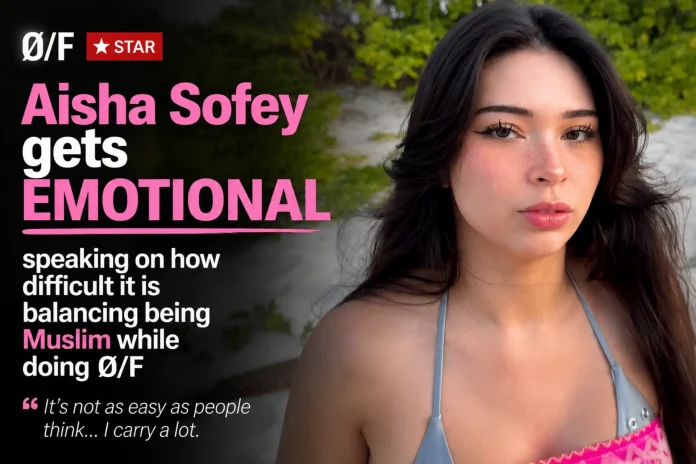
In a beach video that has circulated widely across social platforms, the 23-year-old influencer Aishah Sofey addressed questions about her life choices with visible emotion, describing the tension between her strict childhood teachings and her current path as an OnlyFans creator and co-founder of the Bop House content collective in Florida.
Sofey, born May 25, 2002, in Canada to a family with French Canadian and Filipina roots, describes the difficulty of building a career through platforms like OnlyFans while knowing those actions conflict with her mother’s expectations. She speaks directly to viewers who have questioned how she identifies both as Muslim and as someone attracted to women.
“I think the thing that people don’t really understand is that it is actually really hard to be Muslim and not straight at the same time,”
she says in the clip. She references her close relationship with fellow creator Summer and explains that outsiders often fail to grasp the internal conflict. The video captures her reflecting on a conservative upbringing, with wind tousling her hair against a backdrop of sand and ocean. Her tone shifts between introspection and direct address as she emphasizes the misalignment with lifelong religious instruction.
This latest moment follows earlier family footage that showed her mother reacting with visible distress upon learning details of her online work. Those clips spread rapidly earlier this year, featuring emotional exchanges where cultural and faith-based values clashed with Sofey’s public persona. Sofey has previously shared stories from her childhood, including attempts to observe Ramadan, highlighting the depth of her early religious exposure even as she has pursued independent success. Her social media presence spans millions of followers across Instagram and TikTok, where she shares fitness, lifestyle, and collaborative content. More details on her background appear on Famous Birthdays.
The situation underscores broader conversations about identity, family expectations, and personal autonomy in the digital age. A recent study found that over half of Gen Z aspires to become influencers, a trend that brings public scrutiny to private struggles. Young creators from traditional backgrounds often face amplified attention when personal growth diverges from familial or cultural origins. Sofey’s willingness to discuss these tensions openly adds a human dimension to debates that frequently become polarized online. Related stories include women leaving adult content careers and returning to faith and OnlyFans creators who speak publicly about their religious beliefs.
Sofey continues to thrive professionally as part of the Bop House group, which has drawn significant attention for its collective earnings and viral appeal. The collective gained wider notoriety after Bop House responded to Kai Cenat’s OnlyFans ban with its own streaming school initiative, positioning itself as an alternative path for creators seeking creative and financial independence outside traditional platforms. Her story reflects the realities many influencers face when personal growth diverges from familial or cultural origins. For those interested in her official presence, visit her verified Instagram profile.
As more creators share such vulnerabilities, audiences gain insight into the complex balance of heritage and self-determination. Research from the Pew Research Center indicates that young adults navigating identity transitions increasingly turn to social media as a space for honest reflection, even when that honesty invites criticism. Sofey’s video serves as a reminder that these journeys involve ongoing emotional labor beyond the polished images seen online. Further context on LGBTQ+ identity and faith is available through GLAAD’s work with LGBTQ+ youth and families.
While some commenters urge her to prioritize faith or family alignment, others express support for her honesty about the difficulties involved. The broader pattern show’s creators from Muslim backgrounds grappling with visibility online. Discussions around queer identity and consumer culture reflect similar tensions, though Sofey’s situation centers specifically on the intersection of religious tradition, sexual orientation, and platform-mediated income.

