

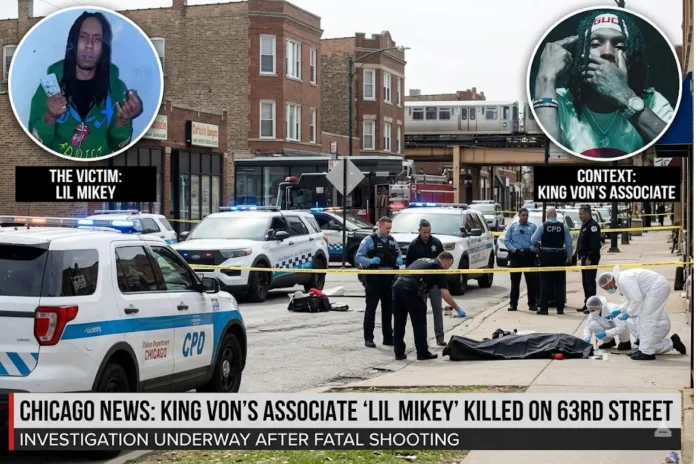
Lil Mikey, a 29 year old drill rapper affiliated with Jaro City and long recognized as a rival to the late King Von, was fatally shot while seated in a vehicle outside a gas station on 63rd Street and Drexel Avenue in Chicago.
The incident unfolded when the woman with him stepped inside the store and an argument erupted nearby, prompting multiple gunshots that struck the rapper. Emergency crews responded quickly to the South Side location but could not save him, and he was pronounced dead at the scene in what multiple accounts described as broad daylight. No suspects have been taken into custody as detectives work to clarify the full sequence.
Lil Mikey had returned to Chicago only months earlier after completing roughly 13 years in state prison on a prior attempted murder case. His ties to Jaro City had long positioned him in opposition to groups such as O Block, the faction tied to King Von, who’s own 2020 killing in Atlanta grew from the same set of disputes. Those tensions have defined much of the drill music world, turning artistic expression into a mirror of real-world loyalties that sometimes prove impossible to outrun. The rapper had begun previewing fresh material that drew directly from his time incarcerated, signaling an intent to channel past struggles into new work.
Video captured in the immediate aftermath shows police vehicles and yellow tape sealing off the gas station area while bystanders reacted with visible distress. Officers moved through the cordoned zone as additional emergency units arrived, though the body remained out of public view. The location itself sits in a stretch of the South Side where similar shootings have occurred before, underscoring how quickly everyday settings can become sites of lethal conflict. Preliminary details shared by those familiar with the scene point to a personal dispute rather than a planned ambush, though the exact trigger and any possible connections to prior rivalries remain under review.
Chicago recorded dozens of homicides in the opening months of 2026 alone, with many involving young Black men in neighborhoods shaped by longstanding gang activity. City data continues to track these cases through official channels even as names are withheld initially to allow families time to grieve. This pattern persists despite repeated calls for intervention at the community level. For ongoing statistics on violence reduction efforts, see the city of Chicago public safety data portal.
The death of Lil Mikey serves as another reminder of how the drill scene both elevates voices from the streets and risks consuming the artists who create it. His story reflects the difficult path many face when attempting to leave incarceration behind while navigating environments where old scores can surface without warning. Families lose sons, partners, and fathers in moments that begin as routine outings and end in irreversible loss. Chicago police maintain active investigations into every homicide, with updates available through their official news releases. Broader context on citywide homicide trends appears in resources such as the Chicago Tribune homicide tracker.
Until deeper roots of conflict receive sustained attention, these cycles of retaliation and grief show little sign of easing.

