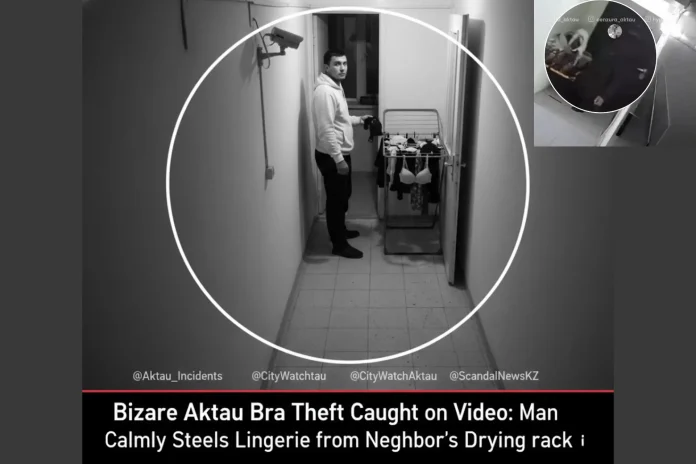
A man dressed in a dark suit calmly stole a woman’s pink bra from a communal drying rack in an apartment building hallway in Aktau, Kazakhstan, an act captured on surveillance video that has triggered a local police investigation and drawn international attention for its peculiarity.
The 48-second viral footage, originally posted on Instagram by the account 112_aktau one day before its wider circulation, shows the unidentified individual entering the dimly lit hallway from the left, carrying a black bag over his shoulder. He pauses to glance around, ensuring the area is clear, before approaching the metal rack where various clothes, including the pink bra, hang to dry. In a deliberate sequence, he reaches for the bra, brings it close to his face in what appears to be a sniffing motion, then folds it quickly and places it into his bag, all while maintaining an unhurried demeanor as he walks away toward the exit. Multiple camera angles in the black-and-white video, overlaid with Kazakh text reading “The man sniffed the woman’s bra and left,” emphasize the brazen theft in this shared residential space, where residents commonly air laundry due to limited private drying options. Authorities in the Mangystau region have launched an effort to identify him, with the police department confirming that a full review of his actions will determine legal consequences.
Online, the video has garnered over 12,000 views on X alone, with engagement including 25 likes and 12 replies that blend humor, speculation, and concern. Comments range from lighthearted jabs like “Wanted to try drag” to more serious observations such as “This is begging behavior of woman serial killer and rapist,” reflecting a divide in public perception. On Instagram, where it amassed 1,800 likes and 657 comments, many users shifted blame to the practice of hanging undergarments in public spaces, with remarks like “No shame, hanging underwear outside, what’s the point” and calls for fines on such habits, highlighting cultural norms around privacy in communal living. This rapid spread illustrates how surveillance technology can amplify minor offenses into viral phenomena, often overshadowing the underlying issues they reveal.
From a psychological perspective, such thefts often link to underwear fetishism, a paraphilia involving sexual arousal from handling or possessing undergarments, which can begin in adolescence and sometimes escalate if unaddressed. Studies indicate that while not all cases lead to harm, a portion of individuals with these fetishes have histories of more severe behaviors, including molestation or assault, underscoring the importance of early intervention through therapy. In some instances, neurological factors like reduced blood flow in brain regions associated with impulse control may contribute, as seen in documented cases where behavioral treatment proved effective. This incident, though petty, prompts a broader examination of mental health support in communities, suggesting that ridicule alone misses opportunities for understanding and prevention.
Incidents like this one expose the tensions in densely populated urban settings, where shared facilities foster convenience but also vulnerability to opportunistic acts. In Aktau, a coastal city on the Caspian Sea known for its oil industry and harsh climate, such communal practices are commonplace, yet they invite risks that technology now readily documents. As the investigation proceeds without reported arrests so far, it encourages residents everywhere to reconsider everyday security measures, blending vigilance with compassion for potential underlying personal struggles. For official updates, consult the Mangystau Regional Police Department site or local reports on BAQ.kz.