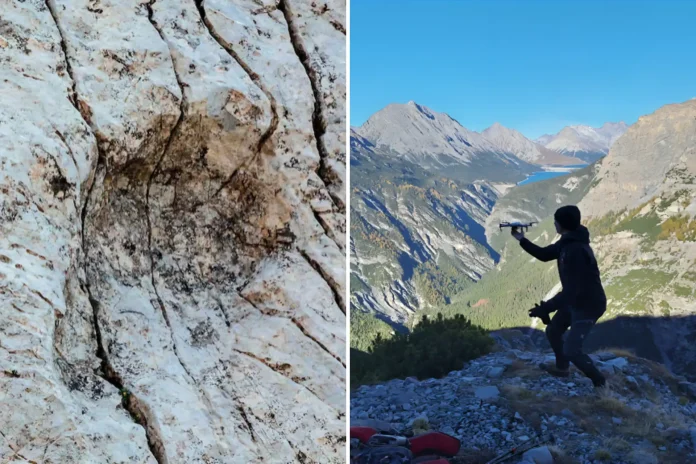
A wild little video clip’s been blowing up all over social media lately it’s this drone footage showing what sure as hell look like ancient dinosaur footprints carved right into these steep cliffs in the Italian Alps. Folks are sharing it like crazy on X and YouTube, and honestly, it’s got that perfect mix of wow-factor and mystery. The 39-second spot flies over these snowy rock faces, zeroing in on these clear-as-day impressions that make you feel like you’re staring at a slice of the prehistoric world smack in the middle of today’s mountains. For us Americans, used to digging up dino stuff in dusty badlands or seeing it behind glass in museums, spotting this up in icy, high-elevation terrain? It’s a total mind-bender.
A tweet from X.
The big deal here is this massive collection of tracks estimates go as high as 20,000 of ’em, dating back around 210 million years to the Late Triassic. They’re up in Stelvio National Park, way up in northern Italy’s Lombardy area, not far from Bormio, which is gearing up to host parts of the 2026 Winter Olympics. These prints are plastered across almost-vertical dolomite cliffs, sitting at over 2,000 meters high. Some individual ones are as big as 16 inches across, with sharp toe and claw marks you can make out plain as day. Experts figure they come from prosauropods, those early plant-munchers that mostly got around on two legs and eventually evolved into the huge sauropods like Brontosaurus. These guys could hit 33 feet long and tip the scales at four tons, and the tracks show signs of them moving in groups, with little juvenile prints scattered among the grown-up ones.
Even though it’s over in Europe, this discovery hits home for Americans too. It’s one of the biggest Triassic dino track sites on the planet, giving us solid evidence that these early dinosaurs hung out in herds. You’ve got these parallel paths suggesting they were trucking along together at a decent clip, and some circular patterns that might point to them bunching up for safety or whatever. And get this the site’s right by ski resorts, which makes you think about places like the Rockies in Colorado or Utah’s canyons. Who knows what ancient surprises are hiding under our own feet, twisted around by millions of years of earthquakes and uplift?
It all kicked off kind of by accident back in September 2025. This wildlife photographer named Elio Della Ferrera was out in the remote Fraele Valley, scoping for deer and vultures with his telephoto lens, when he spotted these weird dips in the rock.
“I saw these unusual depressions on this near-vertical dolomite wall,”
He said in some interviews. He tipped off paleontologist Cristiano Dal Sasso from Milan’s Natural History Museum, who was skeptical at first but quickly changed his tune once he checked it out. Dal Sasso called it “one of the largest and oldest footprint sites in Italy” and said it’s among the most jaw-dropping things he’s seen in his 35 years on the job. Teams from MUSE in Trento and local officials kept it quiet until mid-December, using drones to map everything since the spot’s so hard to reach on foot.
The video that’s gone viral really sells the drama: sweeping aerial shots over these rugged, snow-speckled walls, packed with clusters of three-toed prints marching in lines. Then it zooms in close to show those crisp claw details, and there’s even some quick animations that imagine these long-necked beasts slogging through a muddy flat by the ancient Tethys Ocean. It’s racked up millions of views, but the real science about how this old tidal plain got shoved up into the Alps by tectonic shifts keeps it from being just another flashy clip.
From a reporting angle, this whole thing shines a light on how everyday people, like photographers stumbling on stuff, can kickstart big paleontology breakthroughs. As Dal Sasso put it in a Phys.org piece, the site’s huge scale
“gives us a unique window into prehistoric life.”
But with the Olympics coming, there’s worry about crowds and erosion messing it up, so folks are pushing for smart ways to protect it while letting people enjoy the area. In these fast-changing times, finds like this are a cool reminder that Earth’s deep history is still out there, scratched into spots you’d never think to look.