

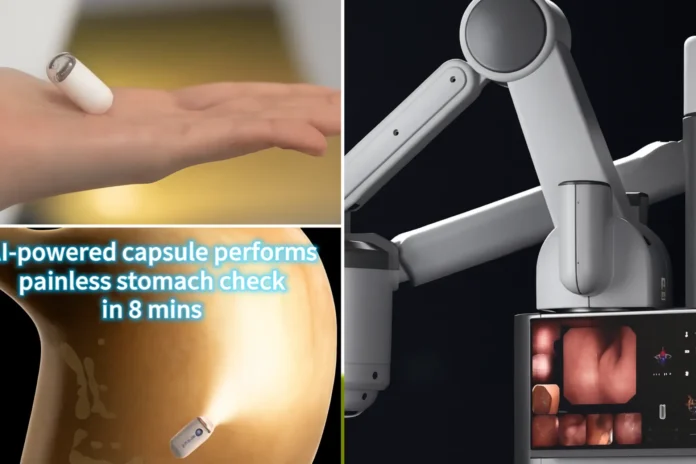
A brief, wordless animation has been making waves across social media. The clip, just 15 seconds long, popped up on X features this sleek, blue-glowing capsule marked “AI-powered.” Someone swallows it without a hitch, and it zips through a cartoonish gut, lighting up the stomach lining, spotting oddities, all wrapped up in eight minutes flat. No needles, no drugs to knock you out. Shared by folks like @rohanpaul_ai back on November 23, 2025, it racked up more than 200,000 views in no time, stirring up equal parts excitement and eyebrow-raising.
Why did it catch fire so fast? People are always drawn to gadgets that promise to make doctor visits less scary, particularly with all the buzz around gentler ways to check insides. Lots of commenters drew lines to the old PillCam from 2001, which just floats along the small bowel on its own. Still, plenty pushed back with doubts real deal or slick marketing? A few called it “PillCam 2.0 with some AI sprinkled on,” fretting over whether these flashy demos overhype what actually happens in a clinic.
A tweet from X.
Look, this isn’t some fresh-out-of-the-lab gimmick magnetically guided capsule endoscopy, or MCE for short, has roots in China going back to the early 2010s. Outfits like Ankon with their NaviCam or Jinshan’s OMOM setup use a tiny camera pill, steered by a magnetic arm outside the body, plus smart AI to sift through the pics. As a 2025 spec sheet from Ankon puts it, the thing’s roughly 27mm by 11.8mm, tips the scales at about 5g, and snaps shots at 2 to 8 frames a second.
Here’s how it goes down, step by simple step. You skip food for 8 to 10 hours, gulp down around a liter of water to puff up your stomach, pop the capsule like a vitamin, then relax on a table. The doc grabs a joystick, tweaks the magnets to nudge it around for a complete look-see. The AI pings any weird spots right away think ulcers or growths. Afterward, it just passes out the natural way. A November 2025 dispatch from Xinhua nails it: “No anesthesia or tubes,” backing up the quick eight-minute scan and a price tag below $280, or roughly 2,000 yuan.
For folks in places like the U.S., U.K., Canada, Australia, or New Zealand, this might sound exotic since Chinese health tech doesn’t always cross over quickly. Sessions usually run 8 to 15 minutes, with the AI nailing detections 80 to 95 percent of the time, drawing from a 2025 roundup in Clinical Endoscopy. In China’s hospitals, you’re looking at $250 to $300 a pop, way cheaper than the $700 to $1,200 for old-school gastroscopy. By mid-2025, millions of these have been done across over 1,000 spots there. That said, while it got FDA nods for stomach views back in 2020 and AI tweaks more recently, it’s not everywhere in the West yet. A big multicenter trial, echoed in BMJ reports, warns it
“cannot perform biopsies and may still require follow-up endoscopy,”
Though it matches up 90 to 95 percent on spotting stuff like inflamed stomachs or lumps.
From a reporting angle, China’s sprint in medical gadgets is leaving some gaps in who gets access worldwide, which could deepen divides in care. One specialist in a 2024 Nature piece summed it up:
“AI models for capsule image review can have very high sensitivity… but results vary by algorithm and lesion type”.
On the bright side, peer-reviewed hubs like PubMed show no big scandals or risks popping up.
At its core, this is legit gear, a staple in China for catching gastric cancer early huge deal with 120 million folks there dealing with gut woes. A 2025 breakdown notes:
“High engagement stems from viral promotion, but replies overlook innovations like Ankon’s MGCE-2 system, validated in studies showing 99% concordance with traditional gastroscopy.”
Sure, it’s got potential, but getting it mainstream in the West means sorting regs, prices, and how it fits docs’ routines. Until then, it’s a teaser for easier checkups ahead, assuming overseers keep pace.
