

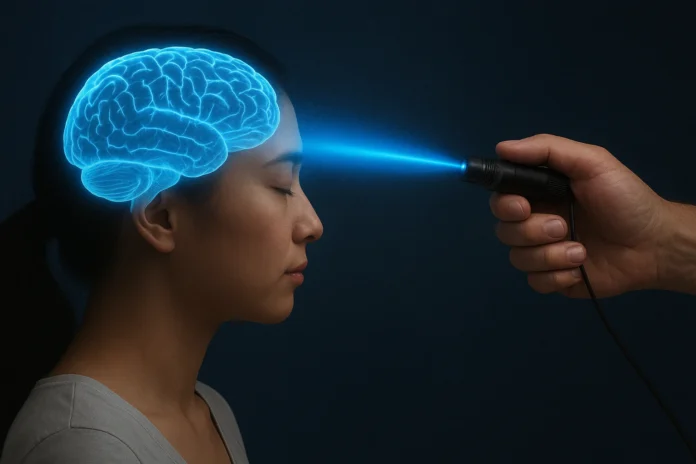
It sounds like something straight out of a sci-fi movie — but it’s real.
A team of researchers in Japan has made a groundbreaking discovery that allows them to selectively erase specific memories using targeted blue light. The experimental technique, which could one day help people struggling with trauma and PTSD, is raising both hope and serious ethical questions.
The process, known as optogenetics, uses light to control activity in the brain. In the new study, scientists directed blue laser light at certain brain connections — called dendritic spines — which are responsible for storing memories. When those connections were exposed to the light, they shrank, effectively erasing the memory tied to them.
What makes the technology even more remarkable is its precision. Researchers say it can remove one specific memory while leaving others untouched — something that’s never been possible before.
Here’s how it works: scientists inject light-sensitive proteins into targeted parts of the brain. When the area is illuminated with blue light, the proteins release molecules that disrupt the brain’s ability to “lock in” that particular memory. In tests on mice, the process successfully removed certain learned memories — even when applied during sleep, when the brain naturally stores new information.
While the research is still in early stages and hasn’t been tested on humans yet, the potential medical applications are enormous. Scientists hope the discovery could eventually lead to treatments for people living with post-traumatic stress disorder (PTSD), severe psychological trauma, or even memory disorders like Alzheimer’s disease.
But not everyone is celebrating the news. Experts are already warning that erasing memories could open up complicated questions about identity and humanity.
“Even our painful memories play a role in shaping who we are,” said Dr. Aiko Yamashita, a bioethicist at Kyoto University. “If we start deleting them, we risk changing the very essence of what makes us human.”
For now, the breakthrough remains in the lab — but it’s clear this discovery could someday redefine how we understand healing, memory, and the human mind itself.
