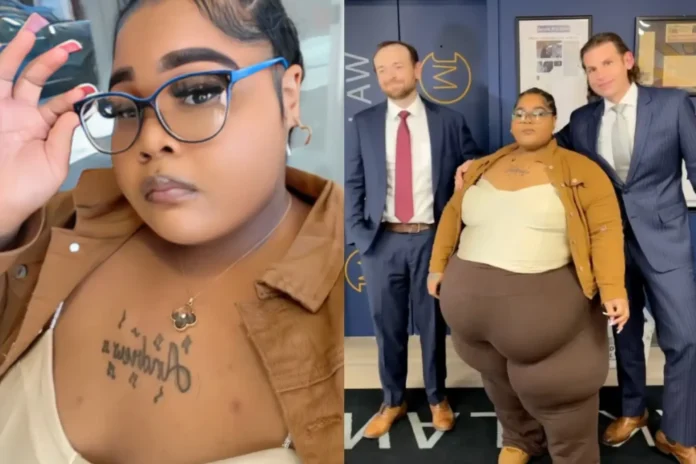
In January 2025, Detroit rapper Dank Demoss real name Dajua Blanding booked a Lyft to attend a Detroit Lions watch party. What should have been a routine ride became a viral flashpoint.
When the driver arrived, he refused to let her into his sedan.
“You can’t fit in this car,”
He told her in a video Blanding recorded on her phone. He added that
“my tires can’t support your weight,”
Suggesting she instead order a larger Uber XL.
A tweet from X.
The clip, shared across Instagram, TikTok, and X , quickly gained traction. Many viewers saw the denial as blatant discrimination, while others defended the driver’s claim of safety concerns.
Blanding, who weighs about 500 pounds, said the rejection left her humiliated.
“I can fit in this car. I’ve been in cars smaller than that,”
She told the driver during the recorded exchange.
She later explained that the moment felt like more than an inconvenience it was deeply personal. In interviews, she compared it to being denied service based on race or religion, categories also protected under Michigan law.
She spoke out widely, echoing years of debate over body size, dignity, and equitable treatment.
Shortly thereafter, Blanding sued the restaurant for discriminatory treatment in Wayne County Circuit Court under the Michigan Elliott-Larsen Civil Rights Act, an uncommon U.S. state statute that prohibits weight and height discrimination.
Her attorney, Jonathan Marko, said at the time:
“I knew that it was illegal, and I knew that it was wrong.”
Fellow attorney Zach Runyan joined in representing her.
The case was settled by summer of 2025. On September 18, attorneys confirmed that Lyft and Blanding had reached an agreement over their conflict, but they declined to name terms. Lyft said the following in a statement:
“Lyft strongly condemns every kind of discrimination. Harassment or discrimination of any kind is prohibited by our community guidelines.”
Twitter users claimed the driver who appeared on social media as “Abraham” was fired but no mainstream outlet has confirmed if he was actually employed.
After the settlement, there were internet rumors that Blanding purchased a van and received an in-house chauffeur so that she did not need to use ride-hailing apps anymore. Pictures and reposts went viral but there is no reputable source that has confirmed whether the van was from the settlement.
What’s clear is that she’s continued to use her platform with her 234,000 Instagram followers and music career to bring about awareness of body positivity and sizeism.
The case put a sensitive problem of ride-sharing front and center companies like Lyft and Uber do not tolerate bias, but drivers are allowed to refuse rides if there appears to be a safety concern. Whether such a concern was actually safety-related or bias-related came to dominate the public debate.
Michigan’s protections made possible this case. Weight discrimination is not typically governed by civil rights law at most U.S. state levels, so commuters like those in this case have fewer options.
The suit also comes as Lyft already sees other lawsuits pending against the company, including a $19.4 million settlement with New Jersey in September of 2025 over driver labor misclassification. Together, each of these lawsuits draws larger liability issues within the gig economy into focus.
For many, the viral video turned into something bigger a civil rights case that forced a global conversation about respect, mobility, and fairness.
What began as a humiliating exchange outside a Detroit watch party grew into a legal challenge that tested the boundaries of civil rights law in Michigan. Dank Demoss’s case against Lyft is more than a story about one canceled ride it is about visibility, dignity, and the right to move freely without judgment.