

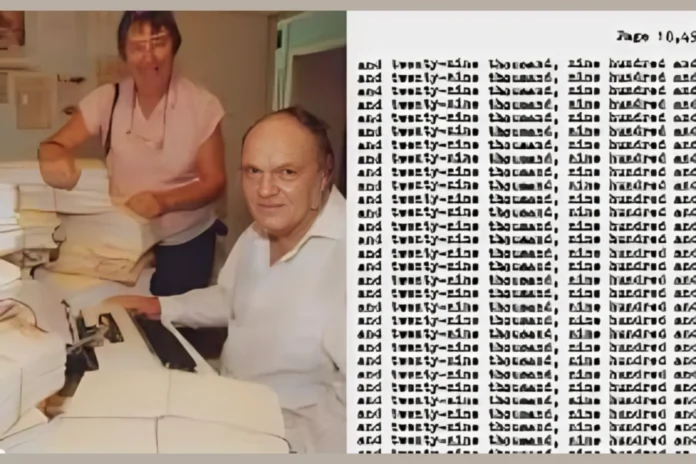
On a quiet street in Mudjimba Beach, Queensland, the steady clack of a manual typewriter echoed through the 1980s and ’90s. Inside, Les Stewart sat at his desk, tapping away with a single finger. Day after day, page after page, he typed the words “one,” “two,” “three,” and onward. Sixteen years later, on December 7, 1998, Stewart finally reached his goal writing out every number from one to one million, in words.
Stewart’s path to this record was one that was characterized by adversity. A veteran himself of Vietnam, Stewart had suffered child hood polio followed by later injuries that had partially paralyzed him. He had worked as a police typing instructor but was pushed into early retirement by illness and financial misfortune.
A tweet from X.
Typing gave him focus.
“I just did what I was best at,”
Stewart once said.
“If you do what you’re good at, then you’re halfway there.”
What began as a way to keep his mind active soon became a monumental project.
From 1982 to 1998, Stewart typed every number fully spelled out between one and one million. That meant “one hundred and twenty-three thousand, four hundred and fifty-six,” not just digits on a page.
He worked with discipline, producing about three pages a day. Each hour, he would type for 20 minutes, resting in between. Over the years, he went through seven typewriters, 1,000 ink ribbons, and close to 19,990 quarto sheets of paper. The final manuscript stacked taller than a man.
The project consumed 16 years of his life. By the time Stewart finished, he had typed more than 25 million characters with just one finger.
Guinness World Records officially recognised Stewart’s achievement in 1999 as the fastest time to type every number from one to one million on a typewriter. The title raised eyebrows after all, it took him 16 years, but no one else had ever attempted the same task.
In 2022, Guinness shared Stewart’s story again on social media, sparking renewed fascination. This September, it went viral once more when a post on X drew millions of views. Some praised his determination. Others wondered why anyone would spend so long on something so repetitive.
The debates didn’t faze Stewart.
“It gave me purpose,”
He explained.
“That’s all I needed.”
Stewart’s record sits among the world’s quirkiest. Websites like Oddee ranked it as one of the strangest Guinness entries. Yet behind the oddity lies resilience. Stewart endured polio, war, a house fire, and financial loss. Typing gave him control over at least one part of his life.
His story echoes other endurance records people balancing spoons on their faces for hours, or swimming non-stop for days. But unlike random feats, Stewart’s work was steady, methodical, and deeply human. It was less about numbers than about patience.
Why does this fascinate us? Perhaps because it shows that persistence, even when applied to something eccentric, still commands respect.
Les Stewart’s manuscript may never be displayed in a museum. Much of it remains in private storage, its stacks of paper gathering dust. Yet his record endures not as a practical achievement, but as proof of human persistence.
Sixteen years, seven typewriters, and nearly 20,000 pages later, Stewart left behind a reminder patience itself can be extraordinary.
