

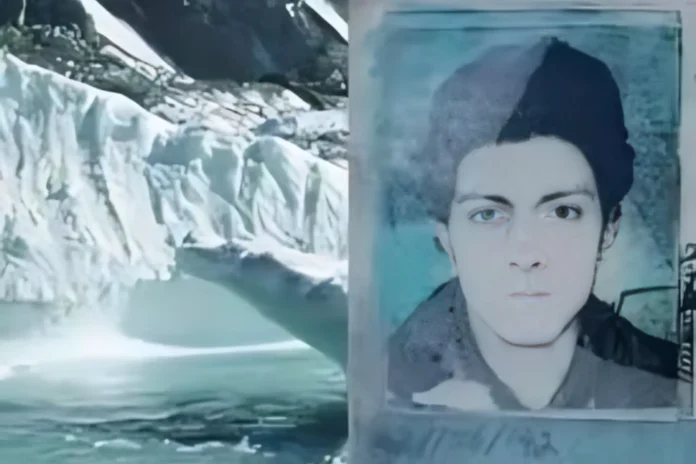
Late in July of 2025, a shepherd called Umar Khan chanced upon something remarkable in rural Kohistan district of Pakistan. Tending his herd in close proximity to the Lady Valley glacier, he chanced upon the extremely well-preserved body of a man, stuck in time for close to three decades.
Locals later identified the remains as those of Naseeruddin, a member of the Saleh Khel tribe, who had disappeared in June 1997, aged just 31 years. His body had been discovered with clothing in place and a national identity card still in his trouser pocket. His brother, Kathiruddin, and nephew, Malik Ubaid, travelled to the site and immediately recognised him.
“We searched for him for years,”
Ubaid told AFP.
“At least now we have an answer.”
Naseeruddin’s disappearance in 1997 was tied to a violent family feud in Pallas Valley. Riding his horse with his brother in hopes of escaping, he was swept in by a snowstorm and reportedly fell into a glacial crevasse. His wife and two children never saw him again.
Throughout the years, the family has had symbolic funerals but never lost hope that his fate could be known in the future. Through the discovery, though saddening, the long anticipated closure has finally arrived. According to the local media, a funeral had been conducted soon after the retrieval of the body from the glacier.
Scientists explain that glaciers act as natural time capsules. Extreme cold, low oxygen, and dry conditions prevent normal decomposition.
“The body was essentially mummified by the ice,”
said Professor Muhammad Bilal of Coms University Islamabad, speaking to local outlets. Similar recoveries have been documented worldwide, from Ötzi the Iceman in the Alps to long-lost climbers on Mount Everest.
In Naseeruddin’s case, experts believe the horse he was travelling with also perished, sealing the tragic event in frozen history.
Pakistan is home to an estimated 13,032 glaciers, more than any country outside the polar regions. But rising temperatures have accelerated their retreat. A recent study found that glaciers in neighbouring Chitral lost around 31% of their area between 1992 and 2022.
The summer of 2024–25 saw record heatwaves in northern Pakistan, triggering dangerous glacial floods and exposing long-buried ice layers. Climate experts warn this incident is both a family tragedy and a glimpse of the broader climate crisis.
Despite family recognition and the ID card, police say DNA testing is still underway to confirm the identity beyond doubt. Outlets have also reported inconsistencies in the glacier’s name some call it Lady Valley, Lady Meadows, or Supat Valley.
For the people of Kohistan, the discovery ends nearly three decades of uncertainty. For scientists, it highlights how glaciers conceal and now reveal human stories.
“This is closure for one family,”
said a local official quoted by The Express Tribune,
“but it is also a warning about how quickly our glaciers are vanishing.”
As ice retreats worldwide, more hidden histories are likely to emerge. In Kohistan, the balance is bittersweet: the return of a long-lost father and brother, and the unsettling pace of a warming planet that brought him back.

