

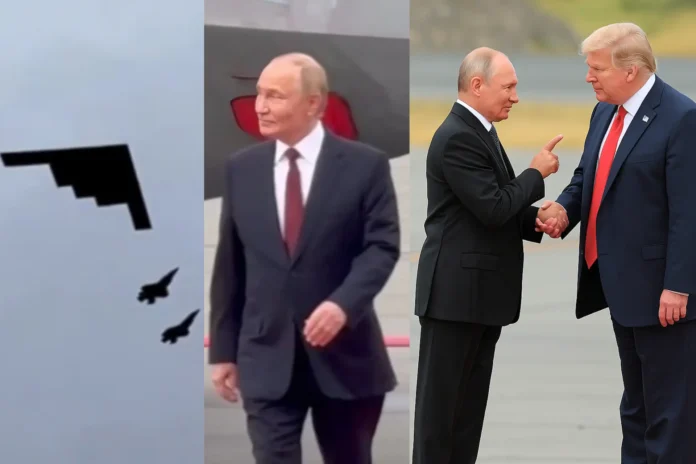
The world held its breath as President Donald Trump and Russian President Vladimir Putin clasped hands on a red carpet in Anchorage, Alaska, on August 15, 2025, kicking off a summit that could reshape global politics. At Joint Base Elmendorf-Richardson, the two leaders smiled for cameras, their handshake symbolizing a rare moment of engagement amid the ongoing Russia-Ukraine war. A U.S. Air Force B-2 Stealth Bomber roared overhead, flanked by F-22 Raptors, in a bold display of American might that briefly startled Putin. This high-stakes meeting, dubbed “Alaska 2025,” sparked intense speculation about its decisions, significance, and the wild conspiracy theories it fueled.
The summit began with Trump landing at 10:22 AM ADT, followed by Putin at 10:55 AM. They shook hands twice—once upon exiting their planes and again on a platform marked “ALASKA 2025,” flanked by four F-22s. A military salute by U.S. personnel added formality, while the B-2 flyover underscored America’s aerial dominance, a pointed message given recent nuclear tensions. The summit, initially planned as a one-on-one, expanded to include U.S. Secretary of State Marco Rubio and Special Envoy Steve Witkoff for Trump, and Foreign Minister Sergey Lavrov and Kremlin aide Yuri Ushakov for Putin.
The choice of Alaska, just 55 miles from Russia across the Bering Strait, was both strategic and symbolic, harking back to its days as a Russian territory before its 1867 sale to the U.S. The primary focus of the Trump Putin summit was ending the war in Ukraine, now over three years long. Trump, who campaigned on stopping the conflict “within 24 hours,” hinted at “territorial swapping” to achieve peace, raising questions about whether he’d push Ukraine to cede land like Donetsk or Crimea. Putin reportedly softened his demands, but details remained murky.
Another key topic was nuclear arms control. Putin suggested discussing treaties like renewing New START, set to expire in 2026. This followed heightened tensions, with Russia’s Dmitry Medvedev referencing the “Dead Hand” nuclear system and Trump deploying U.S. nuclear submarines. Observers speculated the summit could address de-escalation or new arms control frameworks. Alaska’s location also fueled talk of economic cooperation and Arctic ambitions. With the region holding 13% of global oil reserves and new shipping routes opening, some speculated the leaders might explore joint energy ventures, potentially benefiting U.S. firms and easing Russia’s sanctions-hit economy.
On August 8, 2025, Trump announced the summit on Truth Social just a week before the event, suggesting urgency but leaving little room for public consultation. Ahead of the meeting, Trump warned of more severe sanctions against Russia, signaling readiness to target other nations like China to pressure Putin economically. Trump’s decision to exclude Ukrainian President Volodymyr Zelenskyy, despite earlier suggestions of a trilateral meeting, drew sharp criticism. Zelenskyy called any deal without Ukraine “dead decisions,” while European leaders warned against a “Yalta 2.0” where great powers dictate smaller nations’ fates.
A successful deal on the Russia-Ukraine war could halt the fighting but risks legitimizing Russian territorial gains and undermining Ukraine’s sovereignty. European leaders, including EU’s Kaja Kallas and UK’s Keir Starmer, insist Ukraine must be central to any agreement. The summit also marks a critical juncture for U.S.-Russia relations, representing the first direct engagement since the 2021 Biden-Putin meeting. A positive outcome could thaw relations, but failure might escalate tensions.
For the transatlantic alliance, Trump’s openness to territorial swaps clashes with established principles. A deal perceived as favoring Russia could strain the NATO alliance, with European leaders already wary of Trump’s approach. For Trump, a ceasefire would fulfill a campaign promise, potentially boosting his image before the 2026 midterms. For Putin, the summit enhances his global standing, portraying him as a peacemaker despite his ongoing aggression.
The summit also fueled rampant speculation online. Trump’s repeated misstatement during an August press conference, calling Alaska “Russia,” sparked conspiracy theories that he planned to sell the state back to Putin. While no evidence supports this, Russia’s historical claim to Alaska added fuel to the fire. On social media, critics suggested Trump might concede to all of Russia’s demands, pointing to his “blind adoration” of the Russian leader.
In the U.S., Trump supporters hailed the summit as a bold step to end the war, while critics feared it would legitimize Russian aggression. In Ukraine, outrage over Kyiv’s exclusion was universal. The summit’s significance lies in its high-risk, high-reward nature. Trump’s gamble to negotiate directly with Putin could yield a ceasefire but risks alienating Ukraine and NATO. The B-2 flyover and sanctions threat reflect a dual strategy, but Putin’s battlefield gains and economic resilience give him leverage. The conspiracy theories, while unfounded, highlight public distrust in Trump’s motives, amplified by his past praise for Vladimir Putin. The absence of concrete outcomes by August 16 suggests this Trump Putin summit was more a diplomatic gesture than a breakthrough, with a second meeting possibly involving Zelenskyy on the table.
