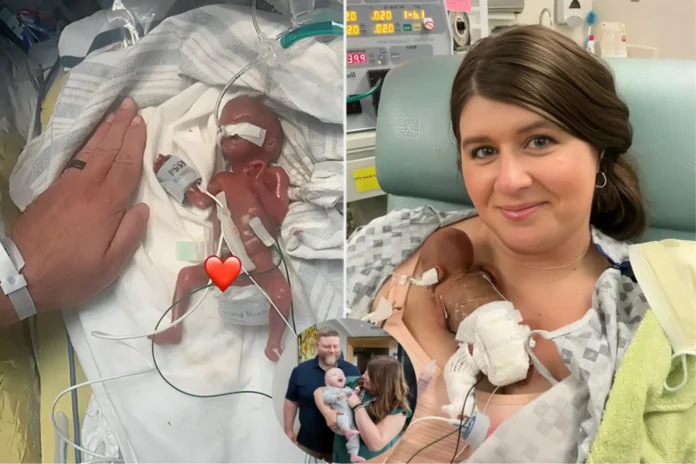
Nash Keen celebrated his first birthday on Ankeny, Iowa, with family members, doctors, and a mountain of gifts 70 new outfits, toys, and a whipped cream-topped cake. Nash was born at a gestational age of merely 21 weeks on July 5, 2024. His survival is a straight-out medical miracle. His parents, Randall and Mollie Keen, call him their “heart stealer,” a lively and cheerful boy who defied the odds to be named the world’s most premature surviving baby by Guinness World Records.
“Nash is so full of personality. He’s a happy baby,”
Mollie Keen said, noting that he’s slept through most nights since coming home.
“Being in the NICU as long as he was, you’d think he’d be more fragile. He’s not. He’s a very determined, curious little boy, and he’s just all smiles all the time.”
Nash was born at the University of Iowa Health Care Stead Family Children’s Hospital in Iowa City, weighing only 10 ounces (283 grams) about the size of a bar of soap. Arriving 133 days before his due date, his birth at exactly 21 weeks gestation marked a precarious milestone. Most hospitals do not attempt lifesaving measures for babies born before 22 weeks due to near-zero survival odds. Yet, the Keens found hope at Iowa’s specialized NICU, known for its advanced care.
Mollie’s pregnancy was complicated. After a traumatic miscarriage at 18 weeks with their daughter McKinley, she was diagnosed with an incompetent cervix and polycystic ovary syndrome (PCOS), issues that predisposed her to preterm delivery. When she went to her 20-week appointment, she was found to be dilated to 2 centimeters, and this was premature labor. Through intervention, they delayed Nash’s arrival long enough to bring it to 21 weeks.
Nash’s survival is due to sophisticated neonatal medicine. Resuscitation, intubation with equipment scaled to his tiny size, and admission to the hospital’s Level IV NICU occurred within a few days of his birth. Around the clock for six months, he was cared for by a team under neonatologist Dr. Amy Stanford and high-risk obstetrician Dr. Malinda Schaefer, with hemodynamic monitoring to maintain his underdeveloped organs within stable parameters. Nash underwent surgery for a perforated bowel and went through numerous health crises, but his improvement left doctors speechless. Nash went home in January 2025.
Dr. Schaefer described the birth of Nash as
“a new frontier in maternal-fetal medicine,”
but emphasized that he would be forthcoming with the Keens regarding the risks.
“It’s ultimately not me that will live with the consequences of parents’ decisions, so it’s really important to have open and honest discussions,”
she explained.
At one year old, Nash remains a spirited child with a charming smile and few tears. Oxygen therapy is continuous 24/7, and he gets a feeding tube and hearing aids to make up for slight deafness. Mild congenital defect in the heart must be carefully monitored, and he attends speech and physical therapy to cope with delayed maturation common in severely premature little ones. Yet, Nash is hitting milestones rolling over, attempting to stand, and preparing to try pureed foods bringing joy to his family and medical team.
A tweet from X.
Resuscitation after 22 weeks takes place in rare instances in hospitals, and severe complications like cerebral palsy or neurological impairment will likely result. The approach of the University of Iowa to treat patients of 21 weeks, with parents’ permission, transcends limits of viability established previously. Neonatologist Patrick McNamara initially briefed the Keens that they wouldn’t survive but was bent on making the attempt.