

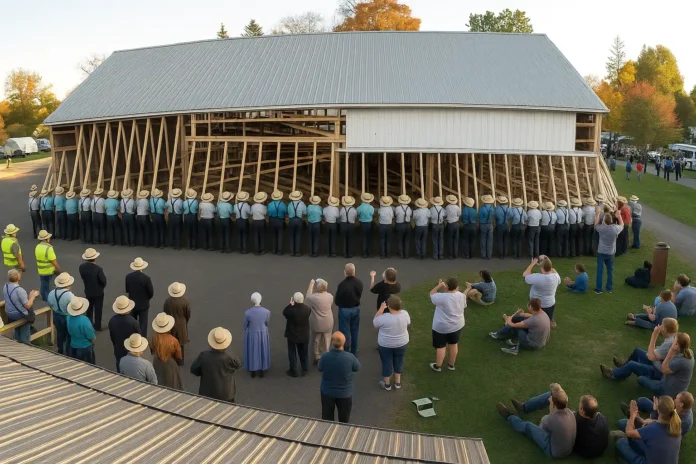
Nearly 800 Amish men in Ohio hoisted a massive 35,000-pound barn and carried it 200 feet across a field without any heavy machinery. This awe-inspiring event unfolded on October 11, 2022, in Geauga County, proving the incredible power of community and raw physical effort. The barn, a 40-by-64-foot structure complete with a loft and corn crib, was relocated in mere minutes, leaving spectators in disbelief.
The feat took place on Nelson and Nancy Yoder’s property, who rallied support by sending handwritten letters to Amish church districts three weeks earlier. Around 5 p.m., men from various communities gathered, some inside the barn and others outside, lifting and moving it to a new foundation. The Yoders prepared by stripping the barn’s aluminum sides and adding wooden frames for easier handling. Women, children, and elders watched, some recording the moment with cellphones and drones, capturing a scene that blended tradition with sheer determination.
This event shines a spotlight on Amish culture, where community, faith, and manual labor define daily life. The Amish, a Christian group, live simply, shunning electricity, cars, and most modern technology in favor of horse-drawn buggies and hard work. Their lifestyle is guided by the Ordnung, an unwritten set of rules that emphasizes humility and mutual aid. This barn move echoes traditional barn raisings, where Amish communities unite to tackle massive tasks in a single day, showcasing their deep-rooted values.
The strength of Amish men, built through years of farming and carpentry without machines, made this possible. Lifting a 35,000-pound barn demands not only muscle but also flawless teamwork, a hallmark of their disciplined way of life. A neighbor, awestruck, said he’d never seen anything like it, underscoring the event’s extraordinary nature.
The Amishstand apart due to their rejection of modern conveniences and unwavering commitment to a faith-driven, simple life. Their distinctiveness traces back to the 1690s, when Jakob Ammann, a Swiss Anabaptist leader, sparked a schism within the Mennonite church. Ammann pushed for stricter practices, like adult baptism, shunning those who broke church rules, and avoiding worldly influences. His followers, called Amish, began migrating to North America in the early 1700s, settling mainly in Pennsylvania, Ohio, and Indiana.
Ammann’s vision influenced the Amish decision to remain apart from the rest of society. Similar to the Mennonites, yet unlike them, the Amish held fast to Ammann’s ideal of purity and simplicity. They moved toward their modern day way of living, avoiding technology in order to remain loyal to their faith and communal way of living. The Ordnung, peculiar to every church district, maintains this with regulations for the likes of clothing and tool usage, to lead the kind of life that is centered upon God, family, and the community’s giving and receiving.
The Amish choose their lifestyle to preserve their faith and community, a decision rooted in Ammann’s teachings and reinforced by their belief that modernity can erode spiritual values. By rejecting technology, they aim to stay connected to the land and each other, prioritizing real-world relationships over digital distractions. Their large families, often with seven to ten children, and education ending at eighth grade in Amish schools, prepare them for a life of manual labor and faith.
A post from X.
Events like the barn move highlight the strength of their community spirit. They believe that cooperating, as witnessed in this incredible achievement, fortifies relationships and indicates their dependency upon one another as opposed to machines. Such a way of living, though demanding, gives a feeling of purpose and fortitude, with lessons learned in sustainability and unity for the modern world.

