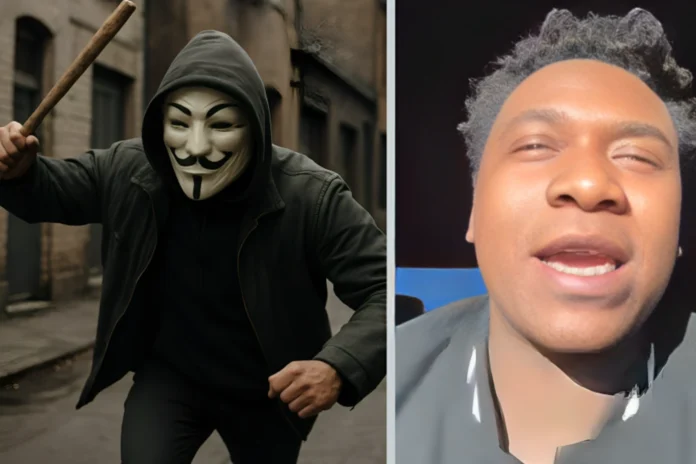
A Louisiana rapper has ignited a firestorm of debate after suggesting on X that the government should designate a state where murder is legal, specifically for individuals engaged in violent activities. The statement, made in a video posted on May 27, 2025, has drawn comparisons to the dystopian film The Purge and has been widely criticized as impractical and dangerous.
While the rapper’s identity remains unconfirmed, his provocative proposal has sparked significant online discussion, reflecting deeper societal frustrations with violence and the criminal justice system.
The rapper’s controversial idea was captured in a 55-second video shared by the X account @mymixtapez at 18:40 UTC on May 26, 2025, which has since garnered over 340,000 views. Speaking from inside a car, the rapper delivered an unfiltered monologue, stating,
“If y’all want the murder rate to go fucking down, why don’t you make a fucking state for straight gray niggas, straight hitters and let us just kill each other. Let us just go dumb, you hear me?”
He elaborated that within this state, individuals could engage in violence without legal consequences, but killings outside its borders would still face prosecution. The rapper framed the proposal as a way to allow people like him to “bang” freely, expressing frustration with police presence and the risks of incarceration.
The statement quickly went viral, with reposts and comments from X users like @LASHYBILLS drew a direct comparison, writing, “So basically like the purge movies,” linking the idea to fictional depictions of legalized crime.
@RockStarRocc highlighted a practical flaw, noting, “This becomes a completely idiotic idea when you consider that people will start kidnapping people and bringing them to that state to kill with no consequence.”
@Bullishhh lamented the mindset, stating, “Young Men used to create families and wealth. Now they just want to kill each other and become the best shooter. SMH. Something has to give.”
High-Profile Murder Cases Involving Louisiana Rappers
Lil Boosie’s First-Degree Murder Trial
In 2009, Torrance Hatch, widely known as Lil Boosie, faced first-degree murder charges in a case that gripped national attention. Prosecutors alleged that Boosie masterminded a $2,800 murder-for-hire plot targeting Terry Boyd, with the act carried out by 17-year-old Michael “Marlo Mike” Louding. The crime occurred just after midnight on October 21, 2009, when six bullets shattered the front window of a house on Vermilion Drive, fatally striking 35-year-old Boyd.
Lacking DNA evidence or eyewitness testimony, the prosecution leaned heavily on a recorded jailhouse confession from Louding. Boosie’s defense, led by attorney Jason Williams, countered that the rapper was being unfairly targeted for his gangsta rap lyrics, which often criticized law enforcement and included themes of racism. They argued that Louding acted independently alongside Michael “Ghost” Judson and Adrian Pittman, pointing to prior disputes between Boyd and these individuals as the true motive.
C-Murder’s Life Sentence
Corey Miller, better known as C-Murder, received a mandatory life sentence in 2009 for the second-degree murder of 16-year-old fan Steve Thomas. The shooting took place at a now-defunct nightclub in Harvey following a confrontation during a rap contest. This conviction was Miller’s second in the case, after an earlier 2003 guilty verdict was overturned.
The sentencing laid bare the profound grief of Thomas’s family. His mother, Dolores, tearfully remarked,
“We still cry every day for our baby. We never got to see him graduate, go to the prom, get married. We won’t have a grandchild to love.”
His father, George Thomas, shared how suppressing his pain triggered a heart attack, landing him in intensive care for four months. Under Louisiana law, Miller’s life sentence offers no possibility of probation or parole.
Hurricane Chris’s Acquittal
In a stark contrast to the above convictions, Christopher Dooley, known as Hurricane Chris, was acquitted in March 2023 of second-degree murder charges related to the 2020 death of Danzeria Farris Jr. The 34-year-old rapper, famous for his hit “A Bay Bay,” faced accusations of shooting Farris multiple times at a Texaco station in Shreveport. A Louisiana jury found him not guilty.
After the verdict, Dooley expressed relief, saying,
“I wanna thank God, my attorneys at the Washington & Wells Law Firm, and my family for standing with me as my life was on the line. They wanted to give me life if I was found guilty.”
He also highlighted the toll the ordeal took, noting,
“This situation drained me and affected my health greatly.”
Lil Snupe’s Tragic Death
The 2013 murder of 18-year-old rapper Lil Snupe (Addarren Ross) underscored the fragility of young talent in Louisiana’s rap community. Tony Holden, 36, was charged with first-degree murder, armed robbery, and illegal firearm possession after allegedly shooting Snupe twice in the chest during an argument over a video game at a friend’s apartment.
Snupe, who had recently signed with Meek Mill’s Dream Chasers label, represented a rising star whose career was abruptly ended. His death highlighted the pervasive violence that threatens emerging artists in the region.
A Growing Legal Controversy
The use of rap lyrics as evidence in criminal trials has sparked widespread debate, exemplified by cases like that of Lil Durk, a Chicago-based rapper whose legal troubles mirror trends affecting Louisiana artists. Durk’s family argued that “the government presented false evidence to a grand jury to indict him” and insisted that “rap is art” that should not be criminalized, reflecting a broader pushback against this prosecutorial tactic.
Academic voices are increasingly weighing in. Jabari Evans, a researcher who testified as an expert witness in a Toronto rapper’s murder trial, advocates for barring rap lyrics and music videos as criminal evidence. His work examines “the intersection of cultural production, race, and legal systems,” with a focus on drill music culture, a subgenre often scrutinized in courtrooms.
Impact on Artistic Freedom
Critics argue that criminalizing rap lyrics infringes on artistic freedom and perpetuates racial bias. Evans has noted that much of what rappers express online or in their music is “part of their artistic persona,” not a literal confession of guilt. In the Toronto case, his testimony helped convince a judge to rule the rapper’s lyrics, videos, and social media posts inadmissible.
This practice, prevalent in both U.S. and Canadian legal systems, has been accused of “weaponizing” creative expression against artists, contributing to convictions and raising questions about equitable treatment in the justice system.
The rapper’s proposal, while extreme, can be interpreted as a provocative form of social commentary. It may reflect frustrations with systemic issues—high incarceration rates, aggressive policing, or the cultural prominence of violence in some hip-hop circles. A 2015 study noted that murder accounted for 51.5% of U.S. hip-hop musician deaths, a statistic that underscores the violent context some artists navigate, potentially shaping such radical ideas.
However, the suggestion raises serious ethical and legal concerns. Critics, like @RockStarRocc, point to potential loopholes, such as kidnapping victims to exploit the state’s legal immunity, which could escalate rather than contain violence. Comparisons to The Purge further emphasize its dystopian impracticality, resonating with real-world debates about crime containment and justice.