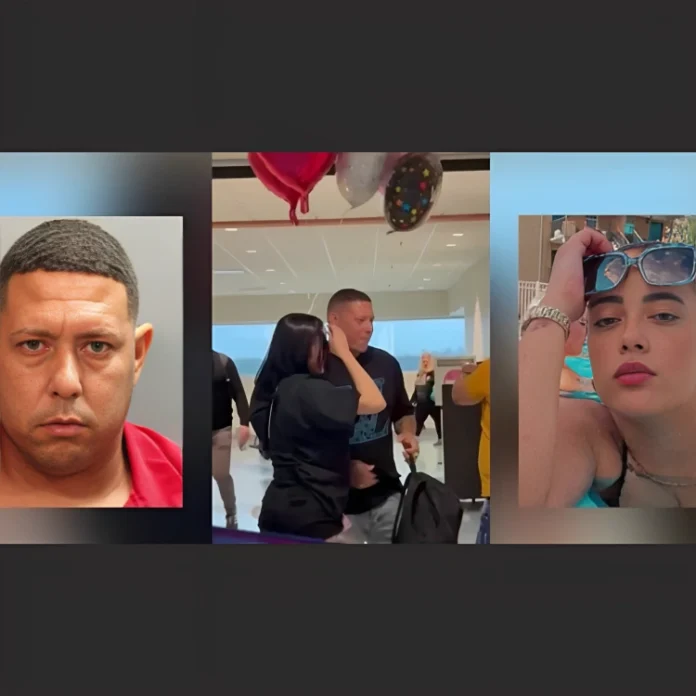
A Cuban man has been arrested and charged with the brutal killing of his partner just days after arriving in the United States.
Jacksonville police found the lifeless form of 30-year-old Yannelis de la Caridad Casales in her apartment on March 30 morning, the victim of a stabbing attack. According to authorities, she had received 15 stab wounds. Nearby, police found her boyfriend, 38-year-old Carlos Yordanis Aldana, with knife wounds on his hand and shin. He was hospitalized at a local facility before being booked into Duval County Jail on the charge of murder.
Tragedy struck just two weeks after Aldana arrived in Florida, where she reconnected with Casales, who had just been released after serving three years in Cuba on his prison sentence. For six years, the two had carried on in long-distance love as Aldana served out her prison term. Casales himself had crossed into the country in search of a better life on an I-220A immigration document, one type of humane parole authorizing temporary presence but no eventual path towards residence.
Family members and close friends characterize Casales as resolute and persistent. She had established a life for herself in America, hanging on in hopes that she would one day be able to be with Aldana. That dream became a nightmare.
Aldana arrived in Jacksonville on March 16, and the two lived together. But in just 14 days, their tale became one of horror. Police were called to an apartment compound in the Arlington neighborhood and, in pursuing a trail of blood, discovered Casales’ lifeless body. Their horror at the crime scene came at the savagery of it: 15 stab wounds.
While Aldana remains in custody and the investigation continues, many questions remain unanswered — about what happened during those two short weeks, and whether any signs of trouble were missed.
Casales was living in the United States under an I-220A document, technically known as an “Order of Release on Recognizance.” It frees people from detention while they wait for additional court proceedings. But whereas other formalities of entry or asylum do confer legal status or at least an explicit path toward permanent residence, this paper does not do so.
Recent court rulings have made it clear that I-220A holders are not “admitted or paroled” but “inspected”; as such, it is difficult, if not impossible, for most, like Cubans such as Casales, to meet the requirements for protection under the Cuban Adjustment Act. That law historically offered Cuban nationals a fast track to residency, but the rules around who qualifies have become increasingly complex.
For Casales, the I-220A permitted her to stay in the country, but on shaky legal ground. For thousands of immigrants like her, life in such status can be stressful, insecure, and isolating.
Back in Santiago de Cuba, Casales’s family is reeling. Her father, heartbroken, has publicly expressed his disbelief over the sudden and violent loss of his only daughter. Her younger brother has helped spearhead a campaign to bring her home.
A GoFundMe page, intended to assist in funeral expenses as well as the repatriation of her remains to Cuba, already has exceeded $11,000 towards its $16,000 target. Support from the local community in Florida, as well as internationally, has been overwhelmingly emotional. Grief-stricken as well as sympathetic messages stream in on a daily basis, sent in great numbers by other immigrants who recognize themselves in the struggles of Casales.
“She came here looking for a better life, not for this,” one supporter wrote on the fundraising page. “She deserved peace, not pain.”
Beyond the tragic human loss, the case has focused new attention on the plight of immigrants with provisional safeguards such as I-220A. These people exist in statelessness legally — yet can’t reasonably settle or create a secure future for themselves, but are still attempting to get their footing in a new world by figuring out difficult systems.
While the investigation into the death of Casales is ongoing, allies are demanding reforms that offer additional safeguards and assistance for vulnerable immigrants, particularly women. For the moment, those closest to her are concerned only with how they can celebrate her life and have her come home for a proper farewell.