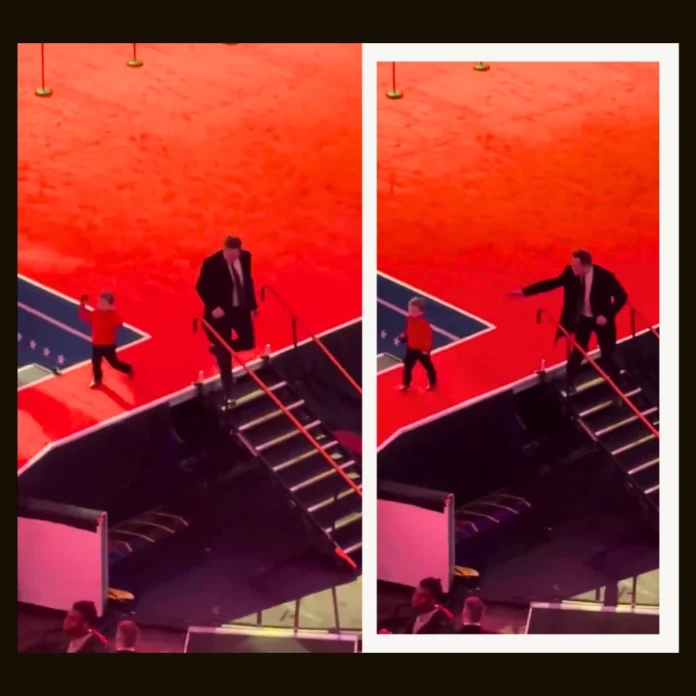
A viral video from Donald Trump’s pre-inauguration rally on January 19 has reignited public scrutiny of Elon Musk, this time over his parenting. The clip, which racked up over 13.5 million views on X, showed the billionaire Tesla CEO abandoning his four-year-old son, X Æ A-Xii, on stage stairs, sparking outrage online. But as full footage emerged, a different story unfolded, raising questions about media manipulation and Musk’s polarizing public image.
The incident occurred at the Capital One Arena, where Musk, a key Trump ally and newly appointed Department of Government Efficiency co-leader, spoke to a packed crowd just a day before the former president’s second inauguration.
In the shortened video, posted by an X user named Mukhtar, Musk is seen striding down the stairs while his son—nicknamed “Little X”—struggles to keep up, prompting accusations of neglect. “Forgot his human shield son,” the caption read, fueling a firestorm of criticism. Comments like
“Why is this man abandoning his toddler on dangerous metal stairs?”
flooded social media, amplifying concerns about Musk’s fatherhood.
But the situation changed with the release of the uncut video by Snopes and others. The video captures Musk freezing and turning and waiting for X to follow and they depart arm-in-arm with arms triumphantly raised. What seemed like a callous moment was, in reality, a brief pause in a father-son interaction—hardly the abandonment the viral snippet suggested.
This isn’t the first time Musk’s parenting has been under the microscope. With 13 children from four partners and a well-documented family history—including the tragic loss of his first child to SIDS and his estranged daughter Vivian Wilson dropping his name in 2022—his personal life is a frequent target.
Just days before the rally, on February 12, Musk’s father, Errol Musk, added fuel to the fire, telling the Wide Awake podcast that Elon “hasn’t been a good dad,” citing his reliance on nannies. The timing of Errol’s remarks and the viral video’s spread has led some to speculate about coordinated efforts to tarnish Musk’s reputation.
Musk’s recent actions may provide a clue. As a vocal supporter of Trump and a driving force behind controversial government efficiency initiatives, he’s ruffled feathers across political and corporate landscapes. His plans to slash federal spending and deregulate industries have drawn ire from bureaucrats, unions, and environmentalists alike. Critics argue that his high-profile role makes him a lightning rod—and a prime target for character attacks.
“Elon’s a disruptor,”
said tech analyst Sarah Coleman of Georgetown University.
“When you’re shaking up the status quo, people don’t just fight your ideas—they go after your image. A doctored video like this can do more damage than a policy critique.”
The fallout from this incident highlights the risks of Musk’s polarizing presence. The edited clip was ammunition for his detractors—an easy way to paint him as a cold, detached figure, unfit for leadership in or out of the boardroom. For supporters, it’s proof of a media eager to twist reality. Either way, the episode underscores a broader trend: Context is often the first casualty in an age of viral content.
The backlash wasn’t limited to online chatter. Some X users called for Elon Musk to face “consequences” for perceived neglect. In contrast, others tied the incident to his broader family controversies, including ex-partner Grimes’ claims of his absence during a child’s medical crisis. Though the full footage debunked the abandonment narrative, the initial damage lingered—proof that perception can outpace truth.