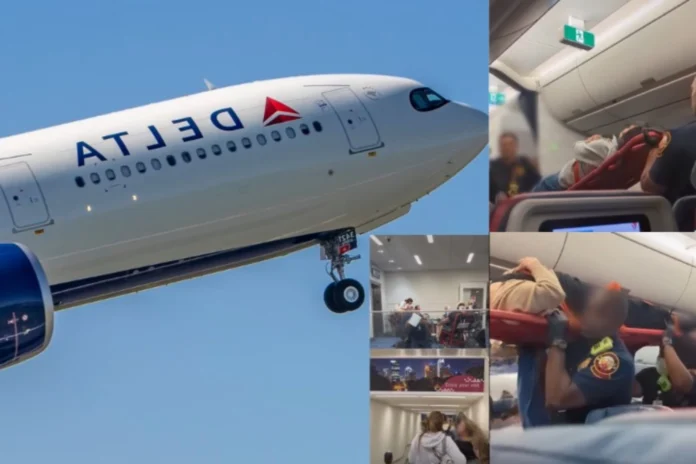
Twenty-five people were hospitalized Wednesday evening after Delta Air Lines Flight 56, en route from Salt Lake City to Amsterdam, encountered severe turbulence, prompting an emergency diversion to Minneapolis-St. Paul International Airport.
Delta Flight 175, an Airbus A350, was approximately 40 miles from Hartsfield-Jackson Atlanta International Airport when it was hit by what passengers described as a violent and sudden drop. The turbulence occurred just before 7 p.m. and triggered emergency response procedures upon landing.
According to data from Flightradar24, the aircraft abruptly ascended over 1,000 feet before plunging nearly 2,300 feet in less than two minutes, before eventually stabilizing. The pilots diverted to Minneapolis, where the plane landed safely at 7:45 p.m. local time.
“The turbulence hit out of nowhere,”
Said passenger Leeann Nash in an interview with KSTP-TV.
“If you didn’t have your seatbelt on — everyone that didn’t — they hit the ceiling. It was terrifying.”
Nash described food carts and bottles becoming airborne during dinner service.
Utah traveler Joseph Carbone recounted the jarring experience in “three waves,” each more intense than the last. “I was off my seat for like 30 seconds,” added William Webster, a frequent flyer who called it “the craziest turbulence” he had ever seen.
Footage posted to social media captured the aftermath on board. At least two individuals were seen being stretchered off the aircraft, while others — including several crew members — wore neck braces and were wheeled through the terminal. One flight attendant was visibly bandaged and fitted with a neck brace, and a passenger could be seen clutching an ice pack to her head.
A passenger who filmed the incident, Instagram user @helloayo, recounted the terrifying moment when the aircraft abruptly dropped. “People were flying out of their seats,” she wrote. “One woman hit the overhead bin and cracked it. Most of the flight attendants were injured.”
One eyewitness reported seeing a young woman “thrown up twice to the ceiling and down” during the incident. “I think she ended up with some fractured ribs,” they added.
Delta Air Lines praised the emergency response in a statement:
“Safety is our No. 1 value at Delta, and our Care Team is working directly with customers to support their immediate needs.”
The Federal Aviation Administration (FAA) confirmed it will investigate the incident — a standard procedure when turbulence results in serious injuries and flight diversions. Weather data from the Rocky Mountain region indicated active storm systems at the time, and multiple aircraft were observed altering their routes to avoid adverse conditions.
Turbulence remains the leading cause of non-fatal injuries on commercial flights. From 2009 to 2022, 34 passengers and 129 crew members suffered serious injuries from turbulence in the U.S., mostly when not wearing seat belts. Flight attendants account for nearly 80% of these injuries due to their mobility during flight.
Experts warn the risk is rising. Research from the University of Reading shows that severe clear-air turbulence has surged between 60% and 155% across global regions since 1980. This invisible threat, often occurring in calm skies, is particularly dangerous because radar cannot detect it.
Scientists are increasingly linking this trend to climate change. Warming temperatures intensify jet streams and wind shear at cruising altitudes, making turbulence more frequent and severe. Projections suggest turbulence could triple globally by mid-century, especially along transatlantic routes.
“The skies are getting bumpier,” said Thomas Guinn, professor of aviation sciences at Embry-Riddle Aeronautical University. “The best defense is staying buckled up at all times.”
Airlines are adapting in response. Korean Air recently curtailed cabin service times and removed high-risk food items following similar incidents. U.S. carriers are also reviewing turbulence detection and mitigation strategies.
Wednesday’s emergency diversion underscores the importance of vigilance, even during routine flights. As skies grow increasingly turbulent, passengers and the aviation industry must remain prepared for the unpredictable.