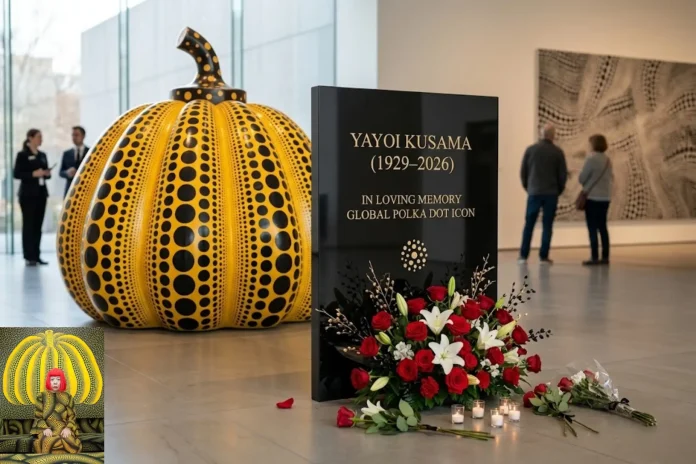
Yayoi Kusama, the Japanese artist who turned polka dots, pumpkins and mirrored rooms into a global visual language, died on August 14, 2026, at a hospital in Tokyo. She was 97 — a death first reported via Reuters. Yayoi Kusama Inc. and Yayoi Kusama Studio Inc. announced her death on Thursday, August 27, saying she painted until her final days.
The official English statement did not list a cause. Artsy and Vulture, both citing her gallery, David Zwirner, said she died of multiple organ failure. A private funeral has already been held for family. A public memorial is planned for a later date.
Kusama was born on March 22, 1929, in Matsumoto, in Nagano Prefecture — one of several Japanese creative figures the country produced in the 20th century. She grew up in a prosperous but harsh household and began drawing as a child while living with hallucinations of dots, nets, flowers and flashing light. Those visions stayed with her. In interviews she said she still saw them. “I had begun to self-obliterate, to revolve in the infinity of endless time and the absoluteness of space, and be reduced to nothingness,” she later remembered.
She moved to New York in 1958 after writing to Georgia O’Keeffe for advice. In the late 1950s and early 1960s she made vast “Infinity Net” paintings, then covered furniture, clothes and a rowboat with stuffed fabric phalluses. She staged Happenings, body-painting events and anti-war performances that put her at the center of the downtown scene and also left her exhausted, often broke and repeatedly hospitalized for overwork.
She returned to Japan in 1973. In 1977 she checked herself into Seiwa Hospital, a psychiatric facility in Shinjuku, Tokyo, and lived there by choice for the rest of her life, commuting to a nearby studio. Art, she said, was how she stayed alive — a sentiment echoed in other recent artist obituaries. “If it were not for art, I would have killed myself a long time ago,” she told The Guardian.
Recognition arrived late. In 1993 she became the first woman to represent Japan with a solo presentation at the Venice Biennale — a record that stood for decades, much like the art-world vandalism cases that have made headlines in recent years. Museum crowds followed in the 2000s and 2010s as her Infinity Mirror Rooms became appointment viewing and social media destinations. A 2017 survey at the Hirshhorn Museum in Washington drew about 475,000 visitors — the highest recorded spring attendance in the museum’s history since it opened in 1974, according to the Smithsonian. A 2024-25 retrospective at the National Gallery of Victoria in Melbourne drew 570,537 people, making it the most-attended ticketed exhibition in that museum’s history.
The Yayoi Kusama Museum opened in Tokyo in 2017. Art dealer David Zwirner, whose New York gallery hosted her first U.S. solo solo show in 2013 and continued to represent her, said after her death that she was “without a doubt, the most famous living artist in the world” — a quote from his official memoriam He recalled visiting her career retrospective at the Museum Ludwig in Cologne earlier that summer — an exhibition the museum later announced as the most successful in its history — a record AP reported in August 2026
The market caught up. Works routinely sold for more than $1 million. Her auction record of $10.49 million was set in 2022 at Phillips for Untitled (Nets) (1959) — one of several high-profile painting sales the market has logged in recent years, a canvas from her early New York years. Collaborations with Louis Vuitton in 2012 and again in 2023 put her dots on handbags, storefronts and city streets. She received Japan’s Order of Culture in 2016.
Later in life she was a small figure in a bright red wig, still producing the “My Eternal Soul” paintings and pumpkin sculptures that museums booked years in advance. The studio statement said she never set her brush aside and kept working on “forever love and eternal soul.” The companies pledged to carry her work forward and, through art, “bring hope and strength for the future to people around the world.”
Kusama’s practice ran across painting, sculpture, installation, performance, fiction and poetry. The motifs never really changed. Dots, nets, pumpkins and mirrored infinity were the same images she described seeing as a child in Matsumoto, scaled up until they filled rooms and, for a time, the public imagination.