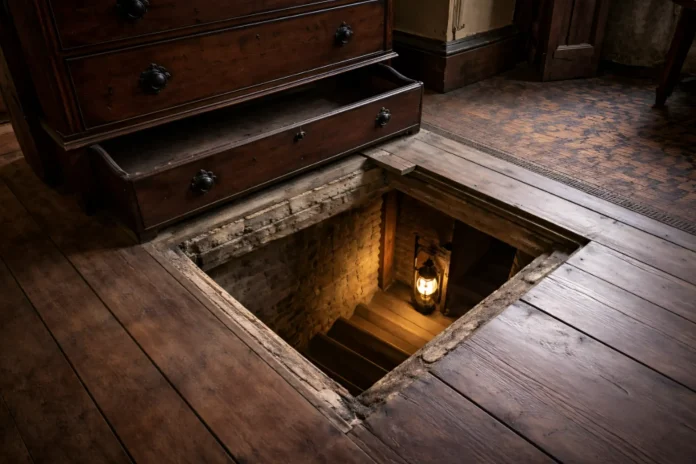
In a hushed corridor of an 1832 townhouse tucked away in Manhattan’s NoHo neighborhood, a group of folks yanked open the hefty bottom drawer of a built-in dresser. What they found made everyone freeze: a jagged 2-by-2-foot gap hacked into the floorboards, leading straight down into pitch-black nothingness.
This wasn’t some random old place it was the Merchant’s House Museum on 29 East 4th Street. That hole dropped into a ladder that went two full stories down to a basement pantry. Historians are now tying it to the Underground Railroad, saying it’s the first solid example of such an entry point discovered in Manhattan in more than 100 years.
The story blew up online after a Spectrum News NY1 segment went viral, pulling in over 1.2 million views. Reporter Cheryl Wills snagged the scoop, complete with footage from the site itself.
A tweet from X.
Tug on that drawer, and the secret pops out. The shaft is narrow, barely room for one person to shimmy through. A basic ladder lines the enclosed drop, landing in a tiny nook below. Experts noticed wax spots along the walls likely from candles lit for sneaky moves in the dark.
Michael Hiller, who’s a professor at Pratt Institute and a preservation lawyer with 30 years under his belt, got a close look.
“This is huge, a once-in-a-generation thing… the biggest deal in historic preservation I’ve seen,”
He told them. He called it a
“brilliant piece of hidden engineering,”
Meant to fool slave hunters or anyone poking around.
Curator Camille Czerkowicz chimed in:
“We’d known about it for a while, but we didn’t grasp what it really was”
Until they dug into old records and pieced it together.
The house belonged to Joseph Brewster, a hat maker and die-hard abolitionist. Architectural historian Patrick Ciccone explained,
“Abolitionists were scarce among rich white New Yorkers back then… Brewster had the means to build this with those intentions in mind.”
The Underground Railroad wasn’t literal rails it was a covert network of paths and safe spots run by folks against slavery, helping enslaved people bolt to freedom. From the early 1800s right up to the Civil War, it got tens of thousands out of the South.
New York ditched slavery in 1827, but it wasn’t a haven. Those federal Fugitive Slave Laws let catchers haul people back south, so hideouts like this were vital for folks heading north. Brewster’s designs for churches with similar setups strengthen the link here.
Local Councilman Harvey Epstein sees it as part of “the ongoing fight for freedom and fairness,” highlighting New York City’s lesser-known role in the abolition movement.
Not everybody’s buying it, though. Over on X, people like @beyrouti are calling it a plain old laundry chute.
“From an architecture standpoint, this looks like a chute from the second-floor bedroom down to the basement for dirty clothes,”
He tweeted, referencing blueprints with a wardrobe above a basement closet and some video inconsistencies about the floors.
Others pile on, noting a 1965 landmarks report that brushed off Underground Railroad tales as baseless. Doubters say the timeline doesn’t fit since New York ended slavery early, but pros argue that runaways from the South still needed protection.
Mostly true the physical tunnel is real, and the Underground Railroad connection holds up with building clues and Brewster’s background, even if it’s more interpretation than a smoking-gun document.
Reporters check this stuff by talking to experts like Hiller on the ground and combing through old plans and pics. No big news source has shot it down yet, but the back-and-forth shows how these buried stories depend on piecing together context, not ironclad evidence.
Discoveries like this jog our memory that New York’s pavements cover stacks of forgotten tales of defiance, often wiped out by the passage of time and new construction. As Ciccone says,
it puts a spotlight on rare tangible proof in a city that’s constantly rebuilding over its history.
The museum’s gearing up to include this in their tours, keeping the spot intact while educating people about anti-slavery figures like Brewster.