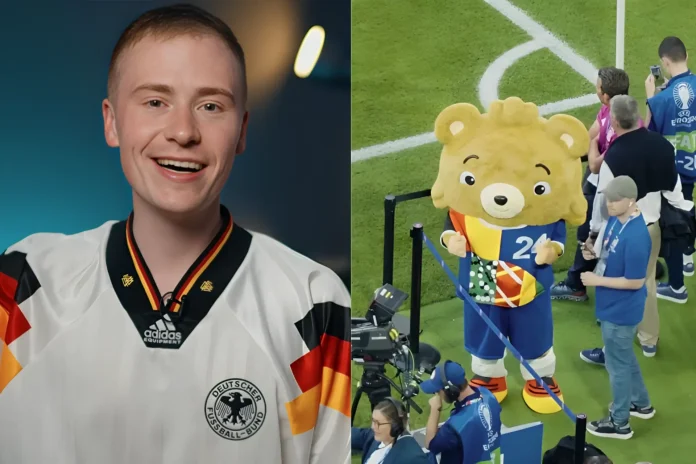
A German YouTuber who dressed up as the Euro 2024 mascot and danced near the pitch during the tournament opener now faces serious legal heat including a potential $26,000 hit nearly two years later. Marvin Wildhage’s viral stunt at Munich’s Allianz Arena has turned from YouTube gold into a courtroom battle over forged documents and event security gaps.
On the date of June 14, 2024, Wildhage gained access to the restricted section at Allianz Arena in disguise as a counterfeit edition of the official mascot for Euro 2024, Albärt (also spelled as Albart). Not only did he manage to enter the stadium, but he also succeeded in reaching the pitch and dancing during the opening ceremony while filming the entire event. Despite the 5-1 win by Germany over Scotland, the major focus was on the security breakdown.
A tweet from X.
Paying close to €3,200 – about $3,400 back then – for a bear suit shipped from China, Wildhage built his plan around chaos disguised as order. Studying pictures online of actual Euro 2024 workers, he mimicked their IDs down to the lanyard styles, replicated QR codes, and forged a parking permit just in case. Alongside two friends, he arrived in a van covered with counterfeit VW and DFB emblems that looked right at first glance. The whole thing moved forward like it belonged, until it clearly didn’t.
At the gate, the fake work IDs failed to scan properly. Security still waved them through after checking the parking pass. Once inside, Wildhage positioned himself among cameramen near the fan block and pitch edge, danced briefly, until a suspicious UEFA supervisor pulled him aside. He was detained but released after the match. Officials confiscated the costume, documents, and equipment, and banned all three from the rest of the tournament.
“As far as his costume, I ordered it online from China for 3,200 euros, and I made the fake accreditation to the tournament using his picture that Euro 2024 staff uploaded on social media,”
said Wildhage when speaking about his own footage.
Wildhage uploaded the full behind-the-scenes video to his channel (which had around 870,000 subscribers at the time), showing the planning, entry, and takedown. It racked up millions of views quickly. UEFA tried to block publication but the footage spread anyway, sparking laughs online and sharp questions about tournament safety.
In fact, his case was brought by the prosecution office in Munich under six charges, including forgery of official documents and fraudulently obtaining services. The prosecution served a fine worth approximately €20,000 to 26,000 ($26,000 USD), which included about 70 daily fines plus potential confiscation of profits earned from the videos (figures between €4,000 to €6,000 were stated). Due to his objections, his case will go to trial on May 13, 2026, in Munich.
In Germany’s “daily fines” system, penalties are scaled to income rather than a flat fee. Experts note a possible additional charge for him sharing screenshots of the official penalty order in another video, which could carry up to a year in prison, although that may be dropped.
This isn’t just a European story. Influencer stunts and pitch invasions happen at U.S. events too think NFL games or college football. The case highlights how easy it can be to exploit human error and visual fakes in high-stakes environments, raising questions about crowd safety and potential worse threats. Similar debates play out in America whenever a viral prank tests stadium security.
The upcoming May 13 court date will decide the financial fallout and could set a tone for how authorities handle monetized mischief in the influencer era. Wildhage’s stunt blended clever planning with clear legal risks: forged official documents aren’t a harmless joke when they breach secure venues.
In the end, this saga shows the double edge of viral content. What generates millions of views and laughs can also bring lasting legal accountability and force big organizations to tighten protocols. As influencers keep pushing boundaries for clicks, cases like Marvin Wildhage’s serve as a reminder that the cameras keep rolling but so do the consequences.