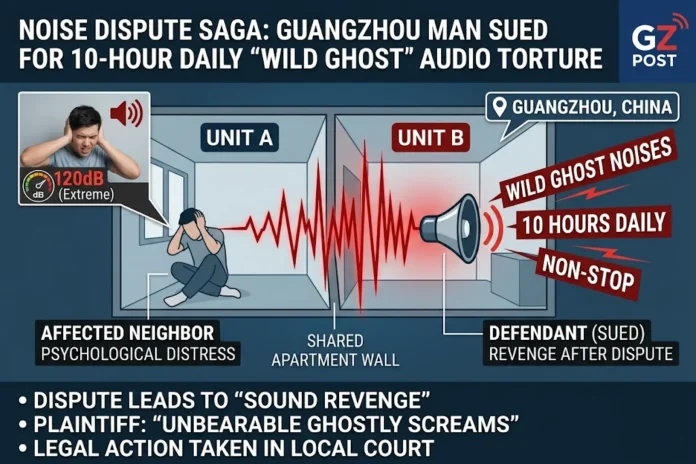
A Guangzhou couple has been ordered by a Chinese court to stop broadcasting eerie ghost stories through speakers pressed against a shared wall for more than 10 hours each day after their disagreement with a neighbor escalated into deliberate psychological harassment. The man surnamed Lu and his partner surnamed Li began the tactic in December 2018 following a dispute with another resident surnamed Xie over issues including a rain shelter and privacy concerns. The looped audio known locally as wild ghost tales seeped through the building and severely disrupted the household of Cui Mousheng who lived two floors above. Police could not intervene because the volume measured only 36 decibels at Cui’s apartment well below official daytime and nighttime thresholds.
Cui and his family endured the constant unsettling narratives during set hours from 8:45 a.m. to noon and again from 3:30 p.m. to 10 p.m. The noise interfered with everyday routines and notably hampered his child’s preparation for the high stakes national college entrance exam. Community mediators and local officials attempted resolution on multiple occasions yet failed to end the disturbance. Cui ultimately turned to the legal system seeking relief to protect his family’s right to a peaceful home environment.
The Haizhu District People’s Court in Guangzhou examined the evidence and ruled that intentional noise creation warranted action even when it stayed under technical limits. On April 14 2022 the court issued the nation’s first noise pollution prohibition order requiring Lu and Li to cease the recordings immediately dismantle their equipment and delete the files while under official supervision. The decision also warned that continued behavior could lead to further liability including potential punitive damages in any subsequent proceedings. Lu and Li complied with the order and later the prohibition was formally lifted after no appeals were filed.
This ruling represents a significant evolution in how Chinese courts handle environmental disturbances in residential settings by focusing on the real world effects on residents rather than strict decibel readings alone. It demonstrates how urban density can transform minor conflicts into inventive yet damaging forms of interference that traditional enforcement mechanisms struggle to address. The precedent established here prioritizes the subjective experience of those affected and offers a practical tool for restoring harmony when mediation falls short. By applying principles from broader environmental protection frameworks the court reinforced that peaceful living qualifies as a core right deserving swift judicial safeguards.
The case has drawn fresh attention in recent national compilations of influential environmental decisions underscoring its lasting value as a model for similar disputes. Details appear in the Supreme People’s Court summary of major environmental trials and related provincial reviews such as those from the Guangdong Higher People’s Court. Such examples highlight the ongoing need for adaptable legal responses in crowded cities where neighbor tensions test the boundaries of tolerance. In the end the resolution brought relief to Cui’s family and illustrated how targeted court intervention can prevent prolonged harm while encouraging all parties to pursue constructive coexistence.