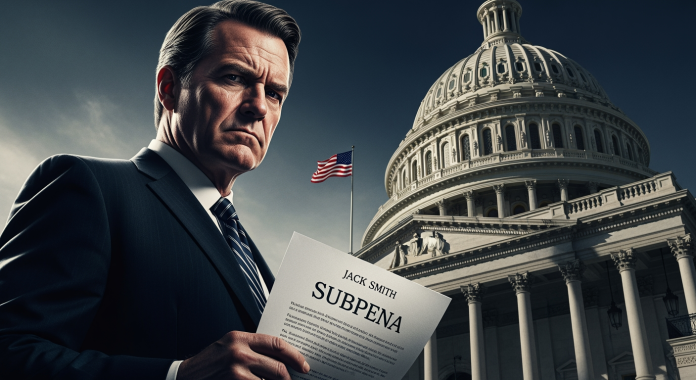
The House Judiciary Committee has escalated its demands to Special Counsel Jack Smith, issuing a direct subpoena that carries an explicit threat of arrest if he fails to comply. This assertive move signals a deepening constitutional clash between Congress and the independent prosecutor’s office.
Lawmakers on the committee are seeking extensive documentation and testimony related to Smith’s ongoing investigations. Their requests particularly focus on inquiries involving former President Donald Trump. Committee members have raised concerns over the investigations’ scope and alleged political motivations, stating that their congressional oversight responsibilities necessitate full transparency from the Special Counsel.
Chairman Jim Jordan (R-OH) has been a vocal critic of the Special Counsel’s activities. He has frequently accused Smith’s office of overreach and partisan targeting. The committee’s threat of arrest underscores its resolve to enforce its demands, asserting its inherent congressional powers to compel cooperation.
Smith’s office has not yet publicly responded to the Jack Smith subpoena or its explicit threat. Legal experts, however, anticipate a robust defense of executive branch independence. Historically, special counsels operate with a degree of insulation from political pressures to ensure unbiased investigations. Non-compliance could trigger a complex legal battle, potentially reaching the Supreme Court.
This standoff carries considerable political ramifications, fueling partisan divides ahead of a critical election cycle. Republicans often perceive Smith’s investigations as politically motivated, while Democrats typically defend the Special Counsel’s autonomy. The situation amplifies broader debates about governmental checks and balances and accountability, particularly concerning the separation of powers.
According to Eleanor Vance, a constitutional law expert at Georgetown University, the committee’s action is highly unusual.
“The explicit threat of arrest for a Special Counsel is a rare and aggressive maneuver, pushing the boundaries of congressional oversight,” Vance says. “It sets a precarious precedent for how independent prosecutorial powers interact with legislative demands.”
— Eleanor Vance, Constitutional Law Expert, Georgetown University
Direct confrontations between Congress and federal prosecutors, though uncommon, have emerged during moments of intense political scrutiny, particularly when government is divided. This unfolding situation now poses a critical test of the separation of powers. Its outcome will undoubtedly shape future interactions between investigatory bodies and the legislative branch.