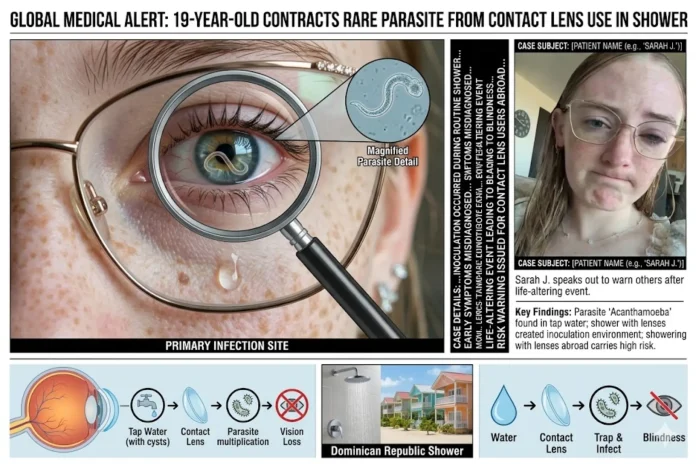
A 19-year-old Los Angeles woman says she began losing her sight after a rare parasite infected her eye while she was showering in the Dominican Republic with contact lenses still in place, turning an everyday habit into a medical emergency that specialists say can lead to permanent blindness if treatment is delayed. Grace Jamison has shared her ordeal publicly to warn other lens users about the hidden risks of water exposure. Her case centers on Acanthamoeba keratitis, an uncommon but serious corneal infection caused by a microscopic amoeba found in tap water, shower water, pools, lakes, and soil. Health experts have long cautioned that contact lenses can trap contaminated water against the eye, creating an opening for infection.
Jamison says the problem began after returning from her trip, when irritation and pain in one eye escalated into worsening vision. She has described the experience as “going blind,” saying the infection caused severe damage and dramatically reduced sight in the affected eye. Ophthalmology specialists note that Acanthamoeba keratitis is frequently misdiagnosed in its early stages because symptoms can resemble more common eye infections. According to the American Academy of Ophthalmology, delayed diagnosis can allow the organism to burrow deeper into the cornea, making treatment more difficult and recovery less certain.
Doctors say contact lens wearers face the highest risk when lenses come into contact with water, whether in a shower, swimming pool, hot tub, or while rinsing lenses improperly. The Centers for Disease Control and Prevention advises users to remove lenses before swimming or showering and to clean lenses only with approved sterile solution. Tap water is not sterile, and even treated water systems can still contain organisms harmless to most people but dangerous when introduced directly to the eye under a lens. That distinction is what makes Jamison’s story so unsettling for millions of routine lens users.
Treatment for Acanthamoeba keratitis can take months and often involves intense medication schedules, specialist monitoring, and in severe cases corneal surgery or transplant procedures. The Cleveland Clinic notes that pain can be severe and vision loss may persist even after the infection clears. Jamison’s warning has resonated online because it reframes a common daily routine as something that requires more caution than many people realize. For many viewers, the biggest surprise is not the rarity of the parasite, but how ordinary the exposure can be.
There is also a broader lesson here about preventive health habits that people often dismiss until something goes wrong. Contact lenses are medical devices, not cosmetics, and they require disciplined hygiene every single day. Replacing lens cases, washing hands before handling lenses, avoiding overnight wear, and keeping water away from them are small steps that can prevent life changing outcomes. Jamison’s case is rare, but eye specialists would likely agree that the behavior behind it is common enough to deserve renewed attention.